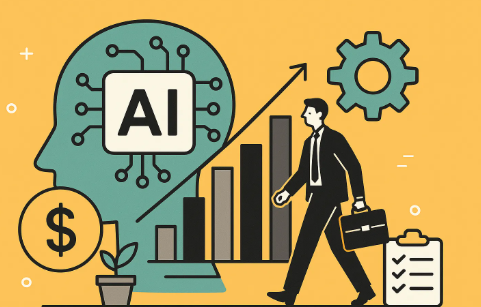

Businesses worldwide are now facing rising operational costs that challenge growth, strain resources, and hinder performance. Hence, leaders, entrepreneurs, and business owners are seeking innovative solutions that automate processes, increase efficiency, and enhance productivity. Artificial Intelligence is becoming the go-to option for addressing these challenges efficiently.
As different sectors evolve, companies are continually adopting AI development to modernize their operations and enhance efficiency levels. By leveraging AI and related technologies, businesses can analyze data-driven insights to streamline routine tasks and make informed decisions. Organizations benefit from enhanced accuracy, faster workflows, and improved resource utilization, ultimately leading to better financial performance.
Here, we will explain how AI helps organizations reduce operational costs and enhance efficiency. We will also discuss case studies and common challenges that every business should be aware of when using AI.
But, before that, let’s understand the reasons why AI is great for cost reduction. So, let’s get started.
Why Does AI Matters for Cost Reduction?
AI plays a vital role in cost reduction as it provides businesses with clearer visibility into operations and reveals inefficiencies that are hidden in daily workflows. It supports informed decision-making by examining data patterns that are beyond the capabilities of humans to interpret.
- Strengthens operational control via constant tracking.
- Enhances precision in planning and budgeting decisions.
- Takes transparency to a new level via workflows and processes.
- Reduces dependence on guesswork with data-driven insights.
- Allows quick response in the case of performance issues.
- Helps leaders allocate resources more intelligently.
- Supports long-term scalability without rising costs.
- Improves consistency in business operations overall.
See also: Exploring the Latest in Gaming PC Australia: Trends and Tech
8 Effective Ways AI Helps to Reduce Operational Costs & Enhance Efficiency
AI empowers businesses to operate with greater versatility, speed, accuracy, and control, delivering tangible results. Here are several effective ways organizations can utilize AI today to reduce expenses and enhance overall efficiency.
1. Automation of Repetitive Tasks Across the Organization
AI-powered technologies and tools, such as Robotic Process Automation, Machine Learning, and Computer Vision, among others, streamline repetitive tasks across various departments, including finance, HR, and support. Thus, enabling teams to focus on strategic tasks.
Automation reduces manual labor by speeding up data entry, invoice processing, and approvals with greater accuracy and consistency. Businesses that have adopted AI have experienced fewer errors, faster workflows, increased productivity, and lower operational costs.
2. Supply Chain and Inventory Optimization
Supply chains are the most crucial part of any business and are even considered complex cost centers.
AI in supply chain analysis examines a significant amount of data to ensure balanced inventory levels and minimize unnecessary carrying costs. It uses real-time data and predictive modeling to anticipate demand, optimize shipping routes, and streamline warehouse operations. It leads to smoother operations, fewer stockouts, and reduced logistics costs through smarter, data-driven planning.
3. Improving Predictive Analytics and Maintenance
Predictive analytics allows organizations to detect equipment failures ahead of time, as they lead to downtime and costly failures. AI models analyze sensor data to predict disruptions in manufacturing, logistics, and facility operations.
This proactive approach reduces emergency repair costs, extends equipment life, and lowers maintenance costs for both large and small businesses.
4. Energy & Resource Management
Energy is one of the crucial expenses for industries and extensive facilities. AI-based innovative energy management systems track usage patterns, detect inefficiencies, and adjust consumption levels smartly in real-time.
Smart controls utilize AI to optimize grid load, enhance HVAC performance, minimize waste, and facilitate optimized resource allocation. Energy providers and commercial buildings greatly benefit from lower utility costs and improved environmental sustainability.
5. Workflow Optimization and Smart Scheduling
Managing a workforce efficiently is one of the most crucial areas where AI can lead to measurable cost savings. Essentially, AI automates workflows by identifying issues and assigning staff more efficiently, thereby minimizing idle hours and enhancing labor cost efficiency. Organizations achieve streamlined operations, expedited approvals, and enhanced productivity with minimal intervention.
Additionally, intelligent scheduling not only saves time for organizations but also enhances employee satisfaction and service quality.
6. Fraud Detection & Risk Reduction
AI identifies unusual patterns in transactions and flags suspicious activities in real-time. Machine learning models constantly learn new fraud tactics and enhance detection accuracy. These models enable businesses to minimize financial losses, assess costs, mitigate compliance issues, and allocate resources effectively in high-risk areas.
7. Customer Service Automation
AI-based chatbots and virtual assistants handle thousands of customer queries instantly and consistently in multiple support channels. Rather than investing in large support teams, businesses can integrate virtual assistants that reduce workload on human agents, resolve common issues, track orders, and even offer personalized recommendations.
AI development service providers can enhance customer satisfaction, provide quick responses, and reduce staffing costs by utilizing automated assistance.
8. Marketing & Sales Efficiency
AI helps to take your marketing efforts to a whole new level by analyzing customer behavior & preferences, and further automating targeted messaging. Predictive tools enable teams to prioritize leads effectively and allocate budgets efficiently. All of this helps increase conversion rates, reduce acquisition costs, and achieve a better ROI with minimal effort.
Case Studies & Success Stories
These companies showcase measurable gains by integrating AI into their operations, setting benchmarks for cost reduction and efficiency.
Microsoft: An enterprise used Microsoft 365 Copilot and saved $56.7 million over three years through task automation and improved workflows.
Amazon and Walmart: These e-commerce giants used AI and machine learning in supply chain and logistics to dynamically reroute deliveries and reduce fuel and labor costs.
JPMorgan: The bank’s software engineers enhanced their productivity by 10 to 20% using the built-in AI coding assistant tool.
Ralph Lauren: The global American lifestyle company used AI for predictive memory management and offering tailored customer recommendations. This has helped the company maintain proper stock levels and increase profitability.
Challenges and Considerations
There is no doubt, AI delivers robust value; however, it also comes with its own set of hurdles that businesses should handle with careful planning and execution.
- Poor or unstructured data makes AI models unreliable and difficult to deploy effectively.
- Shortage of professionals having skills related to building, scaling, and growing AI systems hinder project progress.
- ROI is challenging to calculate if a business doesn’t have proper goals, metrics and timelines.
- Over-automation can backfire when human oversight is reduced too much.
- AI models require ongoing monitoring and updates to remain accurate.
- Existing legacy systems and siloed data slow AI adoption and complicate scaling efforts.
Final Thoughts
AI is revolutionizing business operations by reducing costs, enhancing efficiency, and improving performance. Currently, we have explored several practical ways AI enhances workflows, reduces waste, improves accuracy, and supports informed decision-making across various areas of an organization. These examples even indicate how AI helps companies to operate smarter and more competitively.
For startups, SMEs, and large-scale enterprises, considering AI development services from a provider is the best option. With these services, businesses can adopt AI smoothly, ensure smooth implementation, and scale the system as needed. With the right approach, businesses can harness the full potential of AI, save money, and achieve greater efficiency over time.