
Key Takeaways
- Open bathrooms feel larger and allow more natural light.
- Closed bathrooms offer more privacy and better moisture control.
- Hybrid layouts combine openness with privacy.
- Choose a layout based on your household needs, space, and style.
- Proper ventilation and lighting are important for any bathroom design.
When planning a bathroom renovation or designing a new home, a fundamental choice emerges: whether to opt for an open or closed bathroom layout. This decision directly impacts your daily comfort, privacy, and the aesthetic of your home. For those looking to explore contemporary options, a custom bathroom design in Annandale, VA may offer inspiration for both styles. Each layout has its own unique advantages and drawbacks, so it’s important to assess which best fits your space, household dynamics, and personal design preferences.
Open layouts often reflect modern thinking and a desire for a brighter, more expansive environment. Closed layouts provide the traditional benefits of privacy and functional separation. Deciding between the two means considering not only your needs but also the limitations and opportunities within your existing space. Homeowners also face challenges related to ventilation, natural lighting, and aesthetics, all of which are influenced by the bathroom’s degree of openness or enclosure. Factors such as the number of people in the home, architectural constraints, and even local property values can significantly influence the right fit for your project. Both open and closed bathroom layouts have devoted followings, but their effectiveness will always depend on individual lifestyle and structural considerations.
Understanding Open and Closed Bathroom Layouts
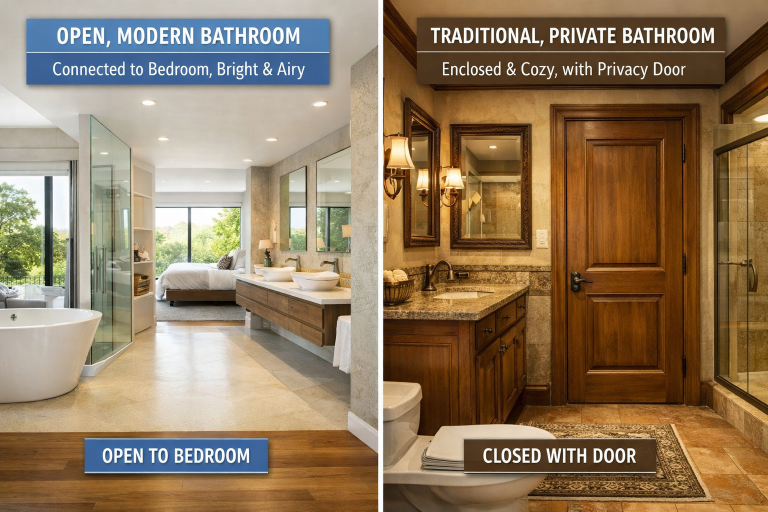
An open bathroom layout typically features minimal barriers between the bathroom and adjoining spaces, sometimes eliminating doors or full walls. This creates a visual continuation from areas such as the bedroom, promoting a sense of airiness and connection. Closed bathroom layouts, on the other hand, keep the bathroom as a clearly defined, private area with solid walls and doors that separate it from the rest of the home.
Pros and Cons of Open Bathroom Layouts
Advantages:
- Enhanced Spatial Perception: Removing barriers makes compact spaces appear much larger and less confined.
- Modern Aesthetic: The clean lines and flowing spaces forgo traditional appearance for a minimalist, up-to-date vibe.
- Improved Natural Light: Windows can serve multiple roles, enabling sunlight to reach deeper into the home and reducing the need for artificial lighting.
Disadvantages:
- Limited Privacy: Without substantial walls or doors, open layouts tend to sacrifice personal seclusion. This can be uncomfortable for households with multiple occupants.
- Moisture and Odor Spread: Steam and scents are not contained, potentially affecting adjacent spaces if ventilation is insufficient.
- Noise Transmission: Water running, fans, and even plumbing noises may intrude into nearby rooms, disrupting quiet moments.
Pros and Cons of Closed Bathroom Layouts
Advantages:
- Increased Privacy: Enclosed walls and doors give users the security of a clearly defined personal space.
- Better Moisture Control: The separation helps contain humidity, protecting the rest of the home from mold, mildew, and general dampness.
- Noise Reduction: Sound barriers keep bathroom activities from interrupting others, especially valuable in busy homes.
Disadvantages:
- Reduced Natural Light: Closed spaces often have limited access to daylight, relying more on artificial lighting, which can impact both mood and design.
- Potential for Cramped Spaces: Especially in older or smaller floor plans, closed bathrooms can feel small or even claustrophobic.
- Traditional Appearance: While cozy, some may find closed bathrooms less exciting or out of sync with evolving architectural styles.
Factors to Consider When Choosing a Layout
Several key considerations should be weighed when making your choice. Households with multiple members or frequent guests generally prioritize privacy and acoustic separation, leaning toward closed layouts. Single-occupant dwellings or those with open-plan homes might benefit from the expansive effect of open bathrooms. Your preferred aesthetic plays a big role, too. Open bathrooms naturally suit modern, minimalist interiors, while closed ones support traditional decor and classic finishes. Further, the existing or potential natural light, as well as the ability to install sufficient ventilation, should guide your final decision.
Hybrid Solutions: Combining Open and Closed Elements
Hybrid layouts mix elements of both open and closed designs, offering versatility and creative solutions. Frosted glass panels, for example, provide privacy while allowing light to pass through. Partial walls, sliding doors, and cleverly positioned partitions can separate the shower area while keeping the vanity or tub connected to the larger space. These blends also allow you to adapt the space over time, giving you the best attributes of both layouts depending on your life stage or changes in occupancy.
Conclusion
The choice between open and closed bathroom layouts comes down to privacy requirements, household configuration, available square footage, and visual taste. Hybrid options offer flexibility for those seeking a middle ground. By weighing the advantages and disadvantages of each approach and assessing practical concerns such as ventilation and lighting, you can craft a bathroom that fits seamlessly with your lifestyle while enhancing your home’s overall appeal.