
As mobile devices move through trade-in, resale, and reuse programs, one concern consistently stands above all others: data security. Businesses that handle customer devices are responsible for ensuring that all personal and corporate data is permanently removed before a device continues through its lifecycle. A data destruction certificate plays a crucial role in demonstrating that responsibility.
Within a structured Device Lifecycle Management framework, a data destruction certificate provides verifiable proof that data erasure has been completed correctly, securely, and in compliance with recognized standards.
What Is a Data Destruction Certificate?
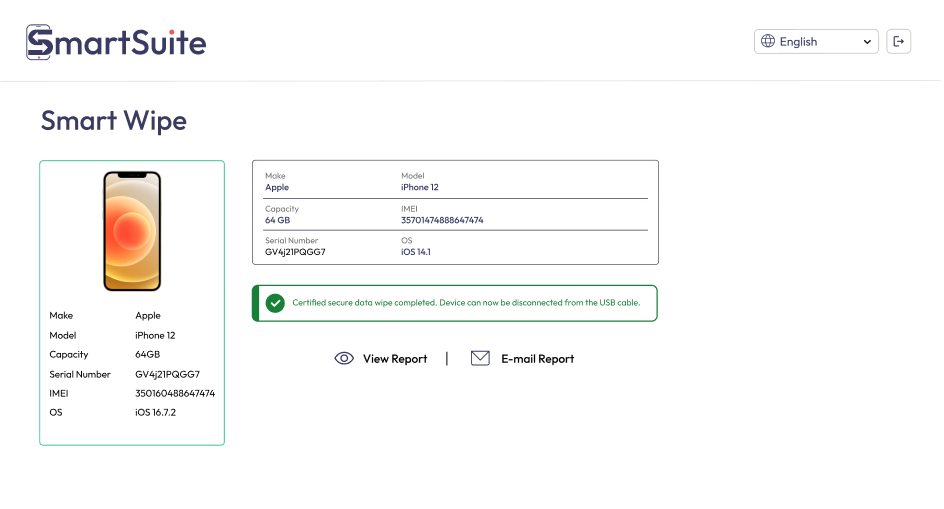
A data destruction certificate is a formal, software-generated record confirming that all data on a device has been securely erased. It documents the completion of the data destruction process and serves as evidence that the device no longer contains recoverable data.
Typically, a data destruction certificate includes:
- Device identifiers such as serial number or IMEI
- Date and time of data erasure
- Method or standard used for erasure
- Confirmation of successful completion
This documentation is essential for businesses operating in regulated environments.
Why Certificates Matter for Businesses
For organizations managing devices at scale, verbal assurances or manual records are not sufficient. A data destruction certificate provides tangible, audit-ready proof that data has been handled responsibly.
Key business benefits include:
- Reduced legal and regulatory risk
- Clear accountability across device programs
- Improved partner and customer trust
- Stronger internal governance
Certificates help businesses demonstrate compliance rather than simply claiming it.
Supporting Customer Confidence Indirectly
While data destruction certificates are generated for business use, they ultimately benefit the business’s customers.
When businesses can prove that data has been securely erased, customers gain:
- Confidence that personal information is protected
- Trust in trade-in and return programs
- Assurance that devices are safe for reuse or resale
This trust is critical for maintaining long-term customer relationships.
Data Destruction Certificates in Device Lifecycle Management
A data destruction certificate is not a standalone document—it is the outcome of a controlled lifecycle process.
Within Device Lifecycle Management workflows, certificates are generated after:
- Device eligibility checks
- Functional diagnostics
- Successful secure data erasure
This ensures that certificates are tied to validated processes rather than manual declarations.
Secure Data Erasure as the Foundation
A data destruction certificate is only as reliable as the erasure process behind it. Lifecycle-focused software supports secure data erasure that meets industry-recognized standards.
Key elements include:
- Complete removal of all user data
- Verification that erasure was successful
- Logging of erasure actions
- Prevention of data recovery
Once these conditions are met, a certificate can be generated with confidence.
See also: The Most High-Tech Hotels in the World Accepting Cryptocurrency Payments
Bulk Data Wiping and Certification
In high-volume environments, businesses often need to erase data from many devices efficiently. Device Lifecycle Management software supports bulk data wiping, allowing multiple devices to be erased simultaneously.
Importantly:
- Only data wiping is supported in bulk
- Each device still receives its own individual certificate
- Erasure results are tracked per device
This balance ensures efficiency without compromising traceability or compliance.
Compliance and Regulatory Readiness
Data protection regulations require businesses to demonstrate that customer data is securely destroyed. A data destruction certificate provides the documentation needed to meet these requirements.
Certificates support:
- Internal audits
- Partner compliance checks
- Regulatory inspections
- Contractual obligations
By maintaining clear records, businesses reduce exposure to penalties and reputational damage.
Reducing Risk in Secondary Markets
Devices entering secondary markets must be free of data. Failure to ensure this can result in serious legal and financial consequences.
Data destruction certificates help businesses:
- Confirm devices are safe for resale
- Protect downstream partners
- Maintain integrity in recommerce channels
This documentation is often required by buyers and partners as part of resale agreements.
Centralized Reporting and Visibility
Lifecycle management software centralizes certificate generation and storage, giving businesses clear visibility into data destruction activities.
This enables:
- Easy retrieval of certificates
- Consolidated reporting across programs
- Improved operational oversight
Centralized records reduce administrative burden and improve efficiency.
Scaling Secure Data Practices
As device volumes grow, manual data destruction tracking becomes unmanageable. Automated certificate generation ensures that secure data practices scale alongside operations.
Scalable advantages include:
- Consistent documentation across locations
- Reduced human error
- Faster compliance reporting
This scalability supports sustainable growth in device programs.
Conclusion
A data destruction certificate is a critical component of responsible Device Lifecycle Management. It provides verifiable proof that data has been securely erased, protecting businesses, partners, and customers alike.
By integrating certificate generation into lifecycle-focused software—and supporting bulk data wiping with individual certification—businesses can operate compliant, trustworthy, and scalable device programs in an increasingly regulated environment.