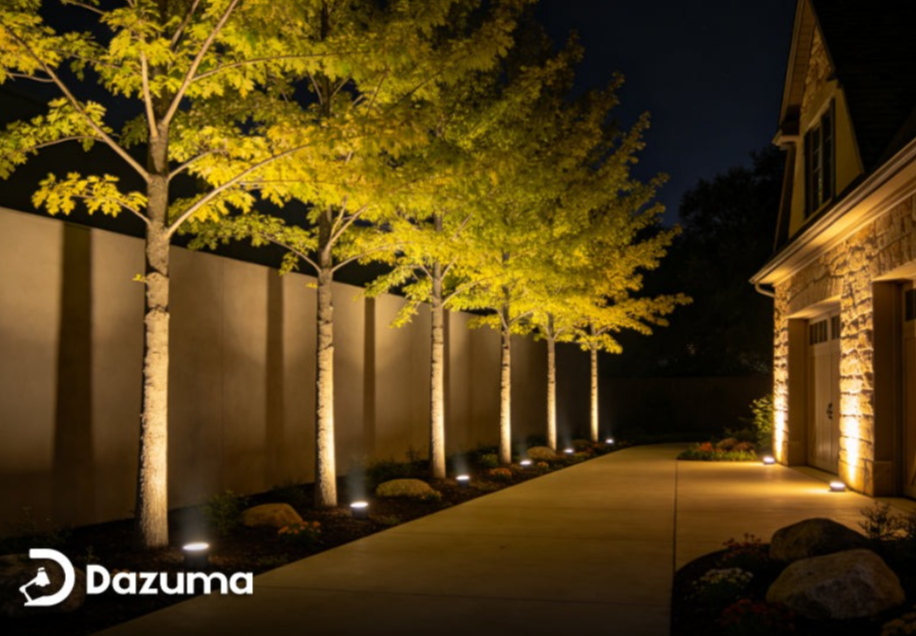

Outdoor lighting works best when you notice the landscape and architecture before you notice the fixtures themselves. A softly illuminated tree, a textured stone wall, or a warm glow along the side of a house can make a property feel completely different after sunset without filling the yard with visible lamps.
Two lighting techniques are especially useful for creating this effect: recessed well lighting and wall washing. They perform different jobs, but when used together they can create a layered nighttime landscape with much more depth than a single floodlight or row of path fixtures.
The key is knowing where each type belongs and resisting the temptation to illuminate every available surface.
Combining concealed ground lighting with broader wall illumination can create depth without filling the landscape with highly visible fixtures.
What Are Well Lights?
Well lights are recessed fixtures installed at or close to ground level. Instead of placing a visible light body above the landscape, most of the fixture sits below the surrounding surface.
This makes them useful when homeowners want the lighting effect to stand out more than the equipment producing it.
They are commonly used around trees, architectural columns, garden features, pathways, decks, and selected sections of landscaping. Depending on the fixture and beam pattern, a well light can send illumination upward toward a tree canopy or create a smaller pool of light around a walking area.
Homeowners comparing different Well Lights should consider installation surface, beam direction, drainage, weather protection, dimensions, and whether the location may experience foot or vehicle traffic.
What Is Wall Wash Lighting?
Wall washing serves a different purpose. Instead of emphasizing one small feature, it spreads light across a larger vertical surface.
A wall washer can be positioned near a façade, garden wall, retaining wall, or architectural feature so that the light travels across a broad section of the surface.
This can make brick, stone, concrete, stucco, and textured cladding much more visible at night. It can also visually connect separate areas of a building that might otherwise disappear into darkness.
Different Wall Wash Lighting designs may use linear or more compact formats, but the basic objective is similar: illuminate a larger surface rather than create one concentrated point of light.
Use Well Lights When You Want the Fixture to Disappear
One of the biggest advantages of recessed lighting is visual simplicity.
In a carefully landscaped yard, adding many visible stakes, posts, or above-ground fixtures can introduce clutter during daylight hours. Well lights reduce that problem by keeping most of the fixture below the surface.
This works particularly well in modern landscapes where clean lines and minimal visual interruption are important.
For example, a mature tree can appear to glow from below without a large spotlight sitting visibly in the planting bed. A column near an entrance can be illuminated from grade without attaching another decorative element to the wall.
Use Wall Washing to Reveal Texture
Some exterior materials become much more interesting when light travels across them rather than hitting them directly from the front.
Natural stone, brick, textured concrete, and rough stucco can develop stronger highlights and shadows after dark. This gives the surface depth and helps the architecture remain visually present after sunset.
The distance between the fixture and the wall affects the final result. Positioning the light very close can emphasize surface texture more strongly, while moving it farther away may create a broader and more even field of illumination.
There is no single correct distance for every project because fixture optics, wall height, texture, and desired effect all influence placement.
Highlight Trees From Below
Trees are one of the most natural applications for well lights.
A recessed fixture positioned near the trunk can direct light upward through the branches and reveal a form that would otherwise disappear at night.
The effect varies depending on the species. Trees with textured bark may look dramatic when illuminated close to the trunk, while larger canopies may benefit from a slightly wider beam or a fixture positioned farther away.
Experiment before final installation whenever possible. Moving the light even a short distance can significantly change the shadows.
Large trees may sometimes need more than one source, but avoid trying to illuminate every branch evenly. Variation in brightness usually looks more natural.
Use Wall Washers to Strengthen the House Itself
Landscape lighting should not focus only on plants.
The house is usually the largest architectural feature on the property, and carefully selected wall lighting can help connect the building to the illuminated garden.
A broad wash across a stone entrance wall can create a focal point. Linear illumination beneath a long façade can emphasize horizontal architecture, while selected vertical sections between windows can create rhythm without lighting the entire building equally.
The objective should be selective emphasis rather than turning the whole exterior into one bright surface.
Combine Both Techniques for More Depth
Well lights and wall washers become particularly effective when they operate at different visual distances.
Imagine looking across a patio at night. A recessed light illuminates a tree in the foreground. Farther away, a softer wall wash reveals the stone façade of the house or a boundary wall.
Now the eye has a foreground and background instead of one isolated illuminated object surrounded by darkness.
This type of layering can make even a relatively compact garden feel deeper because the lighting establishes several visual planes.
Do Not Light Every Tree and Wall
One of the easiest ways to weaken an outdoor lighting design is to give every feature equal attention.
If every tree is uplighted and every exterior wall is fully washed, the landscape loses hierarchy. Nothing stands out because everything is competing for attention.
Choose the strongest features first.
You might illuminate one mature tree, one architectural wall, and the main path rather than installing lights throughout every planting bed.
Dark areas are not a failure of the design. They provide the contrast that makes illuminated surfaces more interesting.
Pay Close Attention to Glare
Upward lighting can create impressive effects, but fixture direction needs careful adjustment.
A well light aimed beautifully at a tree from one viewpoint may shine directly toward someone approaching from another direction. A wall washer can produce similar problems if it sends light beyond the intended surface.
After installation, walk around the entire property and view each light from paths, seating areas, driveways, and important windows.
The source should ideally remain discreet while the illuminated object receives most of the attention.
Drainage Is Especially Important for Recessed Lights
Because well lights sit at or below ground level, water management is an important part of installation.
Simply placing a recessed fixture into soil without considering drainage can allow water to collect around it during rain or irrigation.
Installation conditions vary, but the surrounding ground should be prepared according to the manufacturer’s instructions and local site conditions. Soil type, irrigation, paving, drainage layers, and fixture construction all need to be considered.
Areas where water routinely pools may require a different approach from naturally well-drained locations.
Choose Outdoor Fixtures for the Actual Environment
Landscape fixtures can be exposed to rain, soil moisture, irrigation, insects, heat, cold, ultraviolet light, and changing ground conditions.
Wall washers may face direct rainfall and sprinklers, while recessed fixtures can experience even more demanding conditions close to the ground.
Always confirm outdoor suitability, protection rating, installation requirements, voltage, and mounting method before purchasing.
Professional installation may be appropriate when permanent electrical wiring, transformers, buried cable, or other electrical work is required.
Use Warm Light for a Softer Residential Effect
Warm light generally works well across residential landscapes because it complements stone, brick, timber, plants, and outdoor living areas.
It can also help exterior lighting feel visually connected to the warm illumination visible through windows.
Whatever color temperature you select, consistency is important. A warmly illuminated tree beside a very cool blue-white wall can make the landscape feel divided into unrelated sections.
Check existing porch and path lighting before adding new fixtures so the overall nighttime scene remains reasonably cohesive.
Final Thoughts
Well lights and wall wash lighting solve different outdoor design problems.
Well lights are useful when you want a discreet ground-level source to highlight trees, columns, paths, and selected landscape features. Wall washers are better when the goal is to reveal a broader architectural surface and give the exterior more visual presence after dark.
Used together, they can create layers that move from planting to architecture without relying on large numbers of visible fixtures.
The strongest result usually comes from restraint. Choose a few features worth highlighting, control glare, leave areas of shadow between them, and let the landscape and architecture remain the focus rather than the lighting equipment itself.