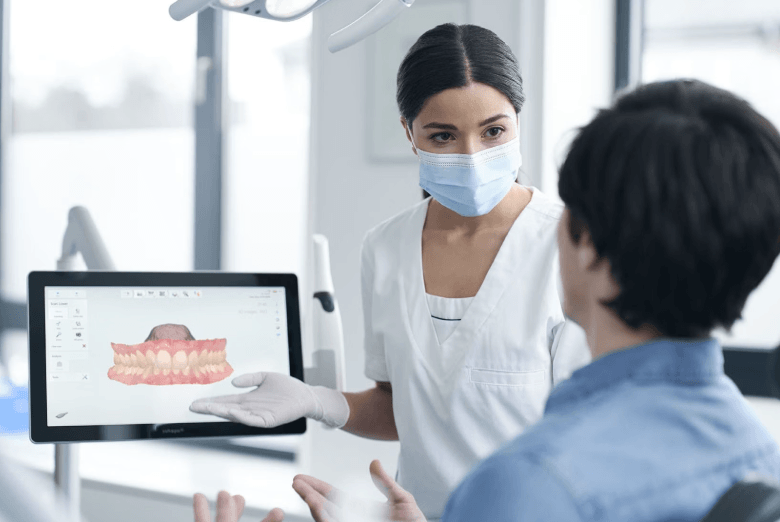

You might be remembering that tray of thick, gooey impression material in your mouth at the Laguna Niguel dental office, trying not to gag, wondering how long you had to sit there and breathe through your nose. Maybe the impression felt uncomfortable, or it had to be repeated because something “didn’t look right” when it came out. You leave the office a bit uncertain, hoping the crown or aligners made from that mold will actually fit.end
Then you hear about digital impressions. A small wand that scans your teeth. No messy trays. Fewer remakes. Better fit. It sounds almost too easy, and because you care about your health and your wallet, you want to know if this is really more accurate or just a new gadget being promoted.
Here is the short version. Digital impressions often provide more accurate, consistent, and comfortable results than traditional impression methods
So where does that leave you if you are trying to decide what is best for your mouth and your peace of mind?
Why do traditional impressions feel so stressful in the first place?
To understand why digital dental impressions can be more accurate, it helps to look at what can go wrong with the older approach. Traditional impressions use a tray filled with material that sets around your teeth. That mold is then poured in stone to create a physical model, which is used to make your crown, bridge, aligner, or denture.
At every one of those steps, something small can go off. The material might not mix perfectly. You might move or gag. The tray might not seat fully. The impression can distort when it is removed. The stone model can get tiny bubbles. Then the model can chip, wear, or even warp slightly over time. None of these issues are dramatic on their own, yet they can add up to a crown that is a bit too high, or a denture that rubs, or aligners that do not quite track.
Because of this tension, you might wonder whether you should simply accept this as “just how dentistry is” or ask for something more precise.
How do digital impressions change that story?
Digital impressions use an intraoral scanner, which is a small camera that takes many images of your teeth and gums, then stitches them together into a 3D model on the screen. There is no tray, no goo, and no need to pour stone models. The scan can be checked in real time, so if a small area is missing or unclear, it can be rescanned immediately instead of discovering the problem days later at the lab.
Research supports this shift. Studies comparing digital and conventional methods have found that digital workflows can reduce errors and improve fit for restorations. For example, a review of digital workflows and 3D printing from the American Dental Association highlights how precise scans feed directly into accurate printed models and restorations, cutting out several error prone steps from traditional methods. You can see a detailed professional guide to this process in the ADA’s resource on digital and 3D workflows, available here.
Other clinical studies have shown that digital impressions can meet or exceed the accuracy of conventional methods for many types of crowns and bridges. A review available through PubMed Central discusses how intraoral scanners often produce restorations that fit within clinically acceptable margins, while also improving patient comfort and reducing chair time. You can explore some of that research in this scientific overview.
So what does this mean for you in practical terms? It usually means better fitting work, fewer appointments for adjustments, and a calmer experience while everything is being planned and created.
Where do digital impressions really stand out compared to traditional molds?
Traditional impressions are not “bad.” Many dentists have used them for decades with good results. Yet when you compare them side by side with more accurate digital impressions, some clear differences appear, especially in consistency and comfort.
The table below highlights some of the most important points you might care about when deciding between the two.
| Aspect | Traditional Impressions | Digital Impressions |
| Comfort during procedure | Requires large trays and thick material. Can trigger gag reflex or anxiety. | Uses a small scanning wand. Usually easier to tolerate and less claustrophobic. |
| Sources of error | Mixing, setting, removal, shipping, and stone pouring can each add distortion. | Captures data directly. Fewer physical steps, so fewer chances for distortion. |
| Accuracy and fit | Can be very accurate, but more sensitive to technique and timing. | Studies show consistent, high accuracy within clinical standards for many restorations. |
| Need for remakes | Errors are often discovered after the lab has worked on the case, leading to remakes. | Problems can be spotted on screen at the visit and corrected immediately. |
| Time in the chair | Impression material must set fully. Repeats add more time. | Scanning is usually faster. If a rescan is needed, it is targeted and quick. |
| Sharing with specialists or labs | Models must be shipped, which takes time and can risk damage. | Files are sent electronically, often within minutes. |
| Use with modern treatments | Works, but may require extra steps for digital workflows. | Integrates directly with CAD/CAM, aligners, and 3D printing. |
Clinical research backs up many of these points. For example, a study indexed on PubMed compared intraoral scanners to conventional impression materials and found that digital techniques often provided equal or better accuracy for crowns and fixed restorations. You can read a summary of those findings here.
So if you are weighing your options, the question is not whether traditional methods ever work. They do. The question is how much you value comfort, predictability, and reduced risk of needing something redone.
See also: Why Preventive Family Dentistry Strengthens Oral Health For Life
What can you do right now to get the most accurate impressions possible?
If you are facing a crown, bridge, implant, or orthodontic treatment, you are not powerless in this decision. You can ask clear questions and set expectations that protect your time, your comfort, and your budget.
1. Ask your dentist what impression technology they use and why
At your next visit, bring it up directly. You might say, “For this crown or aligner treatment, will you be using traditional impressions or a digital scanner, and what does that mean for accuracy and fit?” A thoughtful general dentist will be able to explain the benefits and limitations of the tools in that office. If they use traditional methods, ask how often they need to remake work due to impression issues and how they handle that if it happens to you.
2. Share any past problems you have had with impressions or fit
If you have gagged during impressions before, or you have had a crown that never felt quite right, say so. This context helps your dentist decide whether a digital scan is better for you or whether they need to adapt their technique. For example, if you have a strong gag reflex, a digital scanner can often make the process much more tolerable, which in turn can improve the quality of the data they collect.
3. Focus on long term value, not just the single appointment
It can be tempting to think only about the upcoming visit. Yet the real value of accurate dental impressions shows up over months and years. A well fitting crown can protect a tooth for a long time. A well fitting denture can prevent sores and frustration. Fewer remakes mean fewer days rearranging your schedule and sitting back in the chair. When you talk with your dentist, ask how their approach supports long term comfort and durability, not just getting through today.
Moving forward with more confidence and less uncertainty
You deserve dental care that respects both your comfort and your time. The shift toward why digital impressions provide better accuracy than traditional methods is not about chasing the newest gadget. It is about removing many of the small, hidden risks that used to be accepted as “just part of dentistry” and replacing them with a clearer, more predictable path to a good result.
The next time you need a crown, bridge, implant, or aligners, you can walk in with better questions and a calmer mind. You know what can go wrong with old methods. You know how digital impressions can protect you from some of that frustration. Most importantly, you know that your comfort and the quality of the outcome are worth speaking up for.
Your mouth, your time, and your peace of mind matter. Use what you now understand about digital versus traditional impressions to choose the approach that gives you the best chance at a comfortable experience and a result that truly fits.