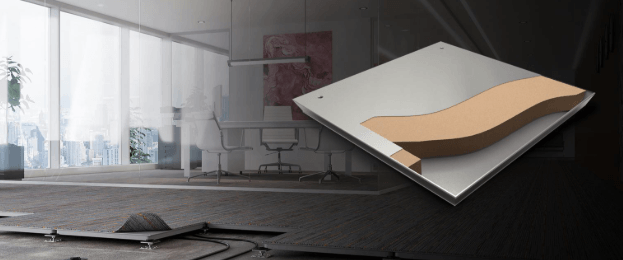
Chipboard Encapsulated Raised Access Floor: Benefits, Specifications, and Applications

Modern buildings require flexible infrastructure that can adapt to changing technology needs while providing reliable performance. The chipboard encapsulated raised access floor system has emerged as a cost-effective, versatile solution for offices, data centers, and commercial spaces that need organized cable management and adaptable underfloor services. This guide explores the construction, benefits, specifications, and applications of chipboard encapsulated raised access floor systems.
Construction and Materials of Chipboard Encapsulated Raised Access Floors
Chipboard encapsulated raised access floor panels consist of a high-density chipboard (particleboard) core fully encapsulated in galvanized steel sheet on all six sides. This construction combines the dimensional stability and cost-effectiveness of chipboard with the durability and moisture resistance of steel encapsulation.
Panel Core Construction
The chipboard core is manufactured from wood particles bonded with resin under heat and pressure. High-density chipboard (700-850 kg/m³) is used for raised floor applications to provide sufficient rigidity and load-bearing capacity. The core’s uniformity contributes to consistent panel deflection characteristics across the installation.
Steel Encapsulation
The galvanized steel encapsulation on all six panel faces creates a complete moisture barrier, prevents chipboard particle release, provides a bonding surface for adhesive-applied floor finishes, and significantly improves panel strength and rigidity compared to unencapsulated alternatives.
- High-density chipboard core (700-850 kg/m³)
- Full six-face galvanized steel encapsulation
- Panel size: 600mm × 600mm (standard) or 500mm × 500mm
- Panel thickness: 28-40mm depending on load requirement
- Surface finishes: HPL, vinyl, carpet tile, or bare steel
Load Ratings and Performance Standards
Raised access floor panels are classified by their load-bearing capacity in accordance with EN 12825 or equivalent standards. Load ratings define the chipboard encapsulated raised access floor load (from furniture legs or equipment feet) and uniformly distributed load (UDL) the panel can support within specified deflection limits.
Understanding Load Classifications
EN 12825 defines load classes from A (light office use) through F (heavy loading for server rooms and industrial applications). Chipboard encapsulated panels typically achieve class B to D ratings, suitable for most office and light data center applications.
Applications and Installation Considerations
Chipboard encapsulated raised access floors are ideal for offices, call centers, financial trading floors, educational facilities, and light commercial data centers. Installation involves setting adjustable pedestals at a defined grid, installing stringers if required, and placing panels to create the elevated floor surface.
- Open plan offices with extensive cabling requirements
- Financial trading floors needing frequent reconfiguration
- Educational facilities with technology integration needs
- Light commercial server rooms and data centers
- Building renovation projects where cable routing is challenging
See also: How Business Speakers Inspire Growth and Innovation
Frequently Asked Questions
What is the lifespan of a chipboard encapsulated raised access floor?
Properly installed and maintained chipboard encapsulated raised access floor systems typically have service lives of 20 to 30 years. Panel replacement is straightforward when individual panels become damaged or are needed for access.
Can raised access floor panels be recycled?
The steel encapsulation can be separated and recycled as scrap metal. The chipboard core can be processed as wood waste. Some manufacturers offer take-back programs for end-of-life panels. Check with your local recycling regulations and manufacturer policies.
What pedestal heights are available for raised access floors?
Pedestal heights typically range from 75mm to 1,200mm or more, accommodating different underfloor service requirements. Lower heights are used where only minimal cable routing is needed, while greater heights facilitate air distribution systems and larger cable bundles.
Conclusion
The chipboard encapsulated raised access floor represents an excellent combination of performance, versatility, and value for most commercial and institutional building applications. Its adaptability to changing technology needs, ease of maintenance access, and long service life make it a sound investment for building owners and operators. When specifying a raised access floor system, work with an experienced supplier who can provide products that meet the load ratings and finish requirements of your specific project.