Replacing a Missing Tooth in Marion, Ohio: Bridges, Implants, and Partial Dentures

Key Takeaways
- A missing tooth can affect chewing, speech, cleaning, and the way nearby teeth meet.
- Fixed bridges, dental implants, and removable partial dentures each replace missing teeth differently.
- The best option depends on gum health, jawbone support, nearby teeth, budget, and personal preferences.
- Every option requires ongoing home care and regular dental visits.
- A complete dental exam is the right starting point for choosing a replacement option.
For many people in Marion, Ohio, a missing tooth affects more than a photograph or a smile in conversation. It may change how comfortable it feels to eat, speak, or enjoy favorite foods with family and friends. A 3 unit bridge is one fixed option for replacing a single missing tooth when the teeth beside the space can provide support. There is no universal answer for every gap. A bridge, implant, or removable partial denture may be appropriate depending on the location of the missing tooth, the condition of the surrounding mouth, the desired treatment timeline, and long-term care preferences.
Why Replacing a Missing Tooth Matters
A missing tooth can create practical concerns even when the space is not visible while smiling. Nearby teeth may gradually move toward an open area, and a tooth in the opposite jaw can shift because it no longer meets a matching tooth. These changes can alter the bite and make some areas harder to clean thoroughly. Replacing a tooth may help restore a more complete chewing surface and support clearer speech, especially when a front tooth is involved. It can also help a person feel more comfortable smiling, talking, and participating in everyday life around Marion.
The Main Tooth Replacement Options
The three common approaches are a fixed dental bridge, a dental implant with a crown, and a removable partial denture. Each approach has potential advantages and limitations, so the choice should come after a personal examination rather than a one-size-fits-all recommendation. Patients considering local restorative care can discuss their goals, health history, and replacement choices with Advanced Smiles Marion as part of a complete dental evaluation.
How Dental Bridges Work
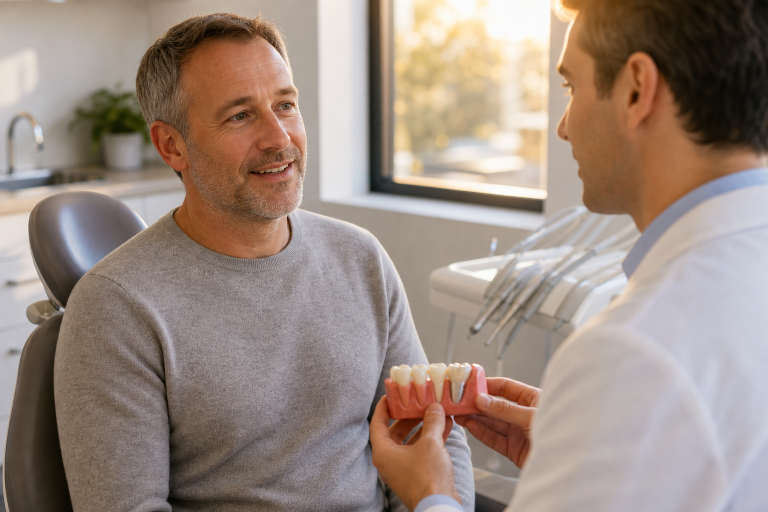
A fixed dental bridge fills the space created by one or more missing teeth. In a traditional design, crowns are placed over teeth on either side of the gap to support the replacement tooth in the middle. Those supporting teeth are often called abutment teeth, while the artificial tooth that fills the space is called a pontic. A bridge can be a practical consideration when neighboring teeth already need crowns or are strong enough to support the restoration. The process commonly includes an examination, preparation of the supporting teeth when needed, impressions or digital scans, a temporary restoration, and placement of the final bridge.
Potential Benefits of a Bridge
- It provides a fixed replacement that is not removed for daily use.
- It may restore chewing function and improve the appearance of a gap.
- It does not require implant surgery.
- It can often be completed without the healing period associated with implant placement.
Points to Consider
- Traditional bridges may require reshaping neighboring teeth for crowns.
- The supporting teeth carry the forces of chewing for the replacement tooth.
- Cleaning under the pontic requires special attention.
- Like other dental restorations, a bridge may eventually need repair or replacement.
A broader comparison of dental bridges and implants can help explain why treatment time, surgery, cost, and maintenance all matter when weighing two fixed solutions.
How Dental Implants Work
A dental implant is designed to replace the root portion of a missing tooth. A dental professional places an implant post in the jawbone, and once it has healed, it can support an abutment and a custom crown. In other treatment plans, implants may support bridges or dentures. Implant treatment generally involves several stages, including imaging and an assessment of the gums, bone, bite, and overall health. Some patients need added treatment, such as bone grafting, before an implant can be placed. Healing time varies so that the implant process may take longer than a bridge.
Potential Benefits of an Implant
- It usually does not rely on neighboring natural teeth for support.
- It provides a fixed foundation for a crown after the treatment is complete.
- It can be used in single-tooth and multiple-tooth replacement plans.
- It may help preserve bone in the area of the missing tooth when treatment is successful and maintained.
Points to Consider
- Implants require a surgical procedure.
- Not every patient has sufficient bone or is an ideal surgical candidate.
- Good gum health and consistent hygiene remain essential.
- Initial costs may be higher than some non-surgical alternatives.
When Partial Dentures May Help
A removable partial denture replaces one or more missing teeth with an appliance that can be inserted and removed. It may be considered when several teeth are missing, when a patient prefers a removable solution, or when a fixed bridge or implant is not suitable. Partial dentures are custom-made, but the fit can change as gums and bone change over time. They should be cleaned as instructed, and patients should follow their dentist’s guidance about wearing and storing the appliance. Compared with a fixed option, they may require an adjustment period for eating and speaking.
Comparing Bridges, Implants, and Partial Dentures
- Fixed or removable: Bridges and implant crowns are fixed after treatment. Partial dentures are removable.
- Surgery: Implants involve surgery. Bridges and partial dentures generally do not involve implant surgery.
- Neighboring teeth: Traditional bridges often use adjacent teeth for support. Implants usually stand independently. Partial dentures may use clasps or other forms of support.
- Treatment timeline: Bridges may have a shorter timeline than implants because implants need healing. Partial denture timelines vary depending on the individual case and the laboratory process.
- Daily care: Bridges need cleaning around crowns and beneath the replacement tooth. Implants need brushing, cleaning between teeth, and gum care. Partial dentures require cleaning of both the appliance and natural teeth.
What Shapes the Treatment Choice?
The location of the gap is only one part of the decision. A dentist may evaluate the health of nearby teeth, the condition of the gums, the available jawbone, the number of missing teeth, bite pressure, tooth grinding, medical history, and comfort with surgery. Insurance coverage, payment limits, and the amount of maintenance a patient can realistically manage also deserve discussion.
Understanding the basic parts and design of a dental bridge restoration can also make it easier to ask useful questions during a consultation.
Daily Care After Tooth Replacement
- Brush twice daily with a soft-bristle toothbrush and fluoride toothpaste.
- Clean between natural teeth every day.
- Use a floss threader, water flosser, or interdental brush if recommended for your restoration.
- Clean removable partial dentures as directed and store them safely when not worn.
- Avoid using teeth or restorations to open packages or bite hard objects.
- Attend regular checkups and professional cleanings.
- Contact a dentist promptly for pain, swelling, looseness, cracks, or bleeding gums.
Questions to Ask Before Treatment
- Which replacement options are realistic for this specific gap?
- Are the teeth beside the gap healthy enough to support a bridge?
- Do I have enough healthy bone and gum support for an implant?
- How long will each option take from planning to completion?
- What costs may be involved now and in the future?
- What cleaning tools or habits will I need at home?
- What happens if the restoration chips loosen or need replacement?
Final Thoughts
Bridges, implants, and partial dentures can all have an important role in replacing missing teeth, but each option involves different considerations for treatment, maintenance, comfort, and long-term use. For Marion patients, the most suitable choice depends on factors such as oral health, the number and location of missing teeth, the condition of the surrounding teeth and gums, personal comfort, treatment goals, schedule, and budget. A dentist may also need to evaluate bone and gum conditions, bite alignment, existing restorations, and other factors before recommending an approach. Patients should understand how each option is placed, how it may feel during daily activities, what type of cleaning or follow-up may be required, and how the treatment fits into their overall oral health plan. A thorough evaluation and open discussion with a dental professional can turn a confusing decision into a clearer plan with realistic expectations for function, appearance, comfort, maintenance, and long-term care.