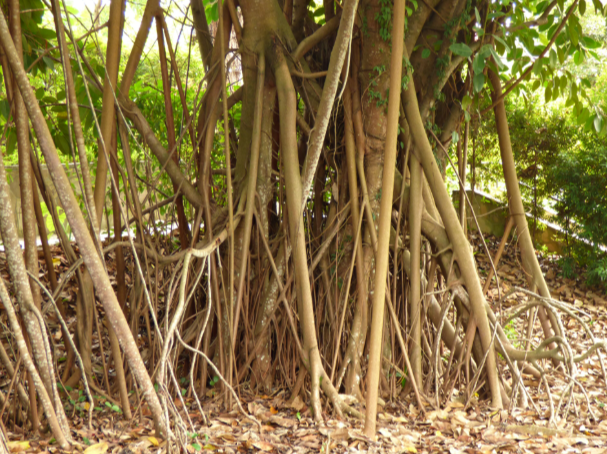

Ficus trees are known for their interesting growth habits, and one of their most recognizable features can be the development of aerial roots. These roots grow above the soil instead of remaining completely underground. They can appear from branches or stems and may eventually extend toward the ground.
For people growing ficus trees indoors, in containers, gardens, or tropical landscapes, aerial roots can initially look unusual. However, they are a natural part of the growth pattern of many ficus species.
Understanding why these roots develop and how to manage them can help plant owners care for their trees with greater confidence.
What Are Aerial Roots?
Aerial roots are roots that develop from parts of a plant located above the soil.
In many ficus species, roots can emerge from branches or stems. When they reach suitable conditions, they may continue growing downward. In nature, some ficus trees develop extensive root systems that help support large structures.
The appearance of aerial roots can therefore be a normal characteristic rather than a sign that something is wrong.
Why Do Ficus Trees Produce Them?
One reason ficus trees develop aerial roots is their natural adaptation to warm and humid environments.
High humidity can encourage roots to develop along stems and branches. In suitable conditions, these roots may grow toward the ground and eventually become established in the soil.
This growth pattern can be especially noticeable in certain banyan-type ficus varieties.
Humidity and Root Development
Humidity can influence aerial root formation.
In a dry indoor environment, a ficus may produce fewer visible aerial roots. In warmer and more humid conditions, root development above the soil can become more noticeable.
This does not mean that plant owners should create extremely humid conditions simply to encourage aerial roots. Overall plant health should remain the priority.
Are Aerial Roots a Problem?
In most cases, aerial roots are not automatically a problem.
They can actually contribute to the plant’s natural structure. The roots may provide additional support as they grow downward.
Problems can occur when roots become tangled, damaged, or interfere with nearby structures. Container-grown plants may also need additional management if aerial roots become too large for the available space.
Should You Remove Aerial Roots?
There is usually no need to remove healthy aerial roots simply because they look unusual.
If a root is interfering with the plant’s location or creating a practical problem, careful pruning may be considered.
However, unnecessary cutting can damage the plant. Any pruning should be performed with clean tools and should avoid excessive removal.
Aerial Roots in Containers
Container-grown ficus trees may produce aerial roots even when they are grown indoors.
If the roots remain above the soil, they may appear as small projections from the stem. Some may eventually grow downward and become longer.
The container should still provide good drainage and appropriate space for the plant’s main root system.
Supporting Larger Plants
In larger ficus trees, aerial roots can become part of the plant’s support structure.
As they reach the ground, they may thicken and contribute to stability. This is one reason banyan-type trees can develop distinctive structures over time.
Gardeners who have enough space may allow these roots to develop naturally.
Watering Considerations
Aerial roots do not mean that a plant automatically needs more water.
The main root system and soil moisture should be considered when deciding when to water.
Overwatering can cause root problems, while severe underwatering can stress the plant. A consistent watering routine based on the soil and growing conditions is generally more useful than watering simply because aerial roots are visible.
When Roots Become a Problem
There are situations where aerial roots require attention.
For example, a root may grow into an unwanted area, interfere with another plant, or become damaged. In a container, extensive roots may also make the plant difficult to manage.
In such cases, carefully inspect the root and determine whether pruning or repositioning is appropriate.
Pruning Aerial Roots
If pruning is necessary, use clean and sharp tools. Avoid cutting multiple major roots unnecessarily.
Small roots that are causing no problem can often be left alone.
After pruning, continue normal care and avoid creating additional stress through excessive watering, repotting, or heavy pruning at the same time.
The Beauty of Aerial Roots
For many plant enthusiasts, aerial roots are part of what makes ficus trees interesting.
They provide a natural, mature appearance and can make individual plants look different from ordinary houseplants.
Some gardeners even choose ficus varieties specifically because of their distinctive root development.
Final Thoughts
Aerial roots are a natural growth feature of many ficus trees. They often develop in response to the plant’s species characteristics and growing environment, particularly humidity.
Rather than immediately removing them, plant owners should first determine whether the roots are healthy and whether they are causing any practical problems.
For people interested in ficus varieties with distinctive root development, an aerial roots ficus can be an interesting addition to a plant collection.