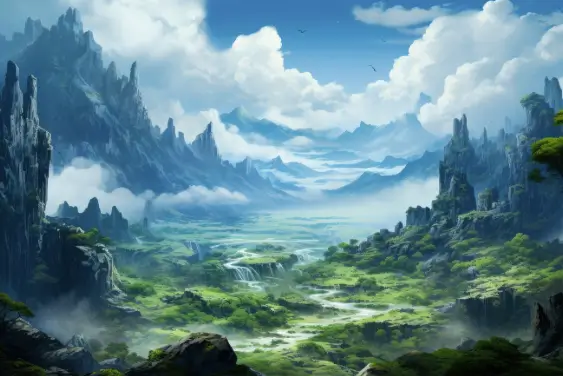

The human imagination has always craved the extraordinary. From the towering crystal citadels of high fantasy to the sprawling, moss-covered ruins of ancient forgotten civilizations, worldbuilding is the cornerstone of immersive storytelling. Whether it is for epic fantasy novels, open-world video games, tabletop RPGs, or cinematic concept art, creating a believable and breathtaking universe requires an immense amount of creative labor.
Historically, environment artists and concept designers would spend weeks or even months sketching, painting, and rendering a single environmental backdrop. Today, we are living in the midst of an absolute paradigm shift. Artificial intelligence has ignited a worldbuilding revolution, allowing creators to instantly visualize, expand, and construct entire mythical dimensions with unprecedented depth and speed.
The Shift from Flat Backdrops to Dynamic Ecosystems
In early digital art workflows, generating a fantasy landscape often meant relying on generic stock templates or repetitive photo-manipulation techniques. These methods frequently resulted in predictable, uninspired environments that failed to capture the true scale of a writer’s or designer’s vision.
Modern generative AI systems have completely shattered these artistic limits. Today’s deep learning algorithms do not merely copy-paste elements like mountains, rivers, or magical castles. Instead, they understand complex spatial geometry, atmospheric perspectives, and the physical laws of light—even when that light is coming from twin alien suns or glowing magical flora. If you are a worldbuilder looking to craft jaw-dropping settings for your next project, exploring specialized engines for fantasy landscapes is the definitive starting point to understand how scale, geology, and atmospheric effects combine to create true structural awe.
[ Text Prompt Concept ] ➔ [ Atmospheric Perspective Rendering ] ➔ [ Environmental Lighting Pass ] ➔ [ Immersive World Asset ]
Streamlining the Workflow of Environment Design
The true magic of the AI worldbuilding revolution lies in how it redefines the pre-production pipeline. For a world to feel alive, it cannot rely on a single wide shot. It requires environmental consistency—meaning the capital city, the surrounding mysterious forests, and the underground cavern systems must all feel like they belong to the exact same geographical and cultural ecosystem.
With multi-layered canvas controls, outpainting, and image-to-image (Img2Img) pipelines, creators can now scale an entire world seamlessly. You can start with a narrow, focused concept shot of a single ancient door and use generative tools to pan outward, revealing a massive temple carved into a snowy mountain face. Utilizing advanced environment design workflows makes it incredibly simple to blend high-quality fantasy art aesthetics, dramatic volumetric fog, and intricate geological structures while maintaining a unified artistic direction across your entire creative portfolio.
Core Pillars of a Masterful Fantasy Worldbuilding Prompt
To break out of standard, generic fantasy clichés and generate landscapes that carry real weight and emotional atmosphere, you must combine geological descriptors with specific architectural, lighting, and environmental styles.
The Worldbuilder’s Prompt Matrix:
[Core Geographical Subject] + [Architectural Motifs] + [Atmospheric Weather & Perspective] + [Lighting Profile] + [Artistic Style/Render Quality]
High-Converting Worldbuilding Prompt Examples:
- The Elven Sanctuary: “A sweeping wide shot of a hidden elven city built into giant redwood trees, cascading waterfalls flowing between wooden bridges. Ethereal morning mist, golden sunbeams cutting through the canopy, high fantasy art style, cinematic depth of field, hyper-detailed.”
- The Volcanic Citadel: “An ancient obsidian fortress towering over a river of molten lava under a dark, ash-filled stormy sky. Aggressive low-key lighting, deep red and charcoal color palette, gritty realism, hyper-detailed cinematic environment design.”
See also: How to Choose the Perfect Front Door for Your Home
Traditional Concept Painting vs. AI-Assisted Worldbuilding
| Worldbuilding Stage | Traditional Concept Method | AI-Driven Creative Pipeline |
| Initial Ideation | 10 to 20 hours of rough blocking and composition. | Under 30 seconds via advanced text-to-image generation. |
| Panoramic Expansion | Redrawing and stretching canvas constraints manually. | Infinite outpainting that generates matching extensions instantly. |
| Atmospheric Testing | Redoing complex lighting layers for night/day cycles. | Prompt swapping (e.g., changing “sunset” to “bioluminescent night”). |
| Asset Scalability | High cost per individual matte painting. | Infinite variations of a single terrain type on demand. |
Real-World Applications Across Creative Industries
The impact of automated environment design extends far across the modern entertainment landscape:
1. Tabletop RPGs and Campaign Groundwork
Dungeon Masters and writers are using AI generators to create stunning visual aids for their players in real time. Instead of vaguely describing an ancient subterranean dragon temple, they can present a highly detailed, immersive image that immediately pulls players into the narrative.
2. Indie Game Level Prototyping
Small indie development teams often lack the budget to hire dozens of environmental concept artists. AI allows a single level designer to rapidly prototype the mood, lighting, and art style of various biomes before handing the concepts off to 3D modelers, saving months of trial-and-error development.
3. Authors and Light Novel Visuals
Fantasy and sci-fi novelists use AI-generated worldbuilding assets to visualize the very landscapes they are writing about. These images serve as incredible references for keeping geographical descriptions accurate throughout a series and can be used for promotional map reveals and book jacket art.
Future Outlook: Fully Interactive, Multi-Angle Universes
As we look ahead, the landscape of AI worldbuilding is moving past static 2D frames. The next evolution involves the generation of consistent, 360-degree panoramic environments that can be projected directly into virtual reality spaces or game engines. Creators will soon be able to generate a static fantasy landscape and instantly convert it into a navigable, three-dimensional skybox or environment grid, bridging the gap between flat concept art and interactive virtual exploration.
Frequently Asked Questions (FAQs)
What is “Atmospheric Perspective,” and why is it important in fantasy prompts?
Atmospheric perspective refers to the way objects become paler, less detailed, and bluer as they recede into the distance due to the air and moisture in the atmosphere. Including this term in your prompts tells the AI physics engine to accurately simulate vast distances, making your mountains and fantasy cities look monumentally huge and realistic rather than flat.
How do I maintain visual consistency across different areas of my fantasy world?
The best strategy is to create a master “Style Blueprint” within your prompts. Use the exact same set of technical keywords—such as specific artists’ styles, camera lens types, color palettes, and rendering parameters—across all your environment prompts. This ensures that a desert biome and an icy peak biome still look like they exist within the same universe.
Can AI image generators handle complex magical lighting, like bioluminescence?
Yes, modern models excel at handling complex light sources. By using explicit prompts like “bioluminescent glowing mushrooms,” “neon ethereal energy lines,” or “crystal structures refracting magical starlight,” the AI will accurately calculate how that colorful light illuminates nearby surfaces, rocks, and characters.
Is AI-generated environmental concept art commercially viable?
Absolutely. Many indie game studios, self-published authors, and content creators use AI-assisted landscapes for commercial product pitches, promotional materials, and background designs. Always check the specific platform’s licensing agreement to confirm you have full commercial exploitation rights for your generated outputs.