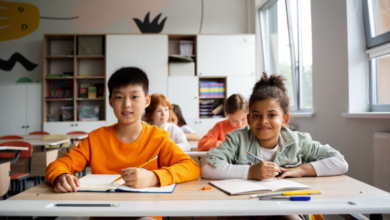

Lesson planning gets all the glory.
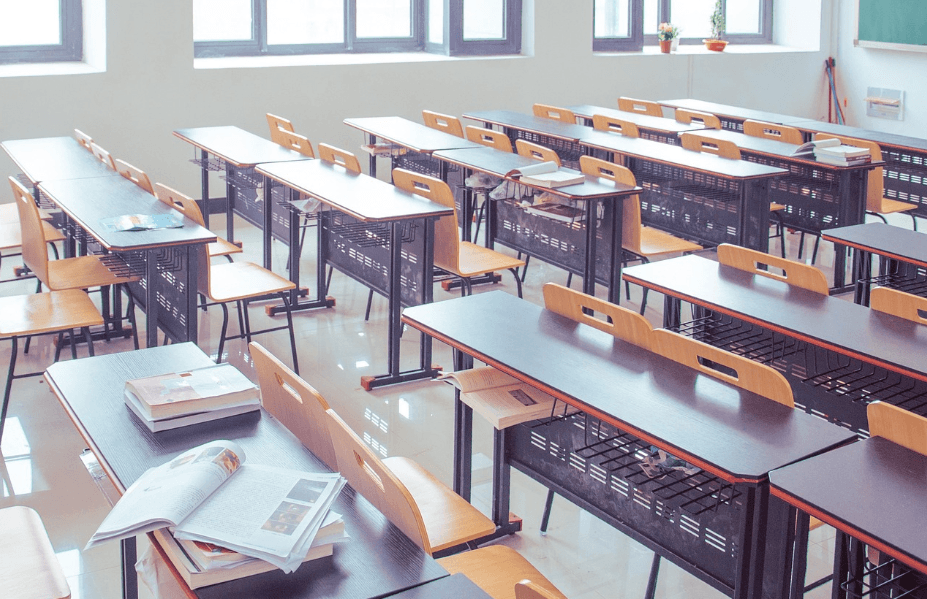
Teachers spend hours on schemes of work, mark policies and CPD sessions. Then those carefully crafted lessons are unleashed into a classroom full of wobbly tables, a jammed window and chairs that were ancient history when the teacher was a student.
Here’s the problem:
A classroom is never unbiased. It’s either with the lesson… or silently against it. And when it’s against the lesson… even the finest teaching fails.
Educational furniture literally sits in the middle of that battle ground. It determines how students sit. It determines how long it takes a classroom to go from collaborative work to independent work. It can determine if a child spends the last twenty minutes of a lesson rocking and squirming to get comfortable.
Here’s why the space deserves as much planning as the lesson…
Here’s what’s coming up:
- The Room Is Teaching Too
- What The Research Actually Shows
- The Buildings Problem Nobody Can Ignore
- What Good Educational Furniture Actually Does
- How To Audit A Learning Space
The Room Is Teaching Too
Walk into any classroom and you can read it in about four seconds.
Rows full-on frontwards talk of one thing. Groups of tables over here suggest another. Broken seats and scraped table edges and a store cupboard door that won’t close speak of … what? Exactly.
Students sense everything. By the time you walk into your lesson, the environment has already communicated to them how important this room is…and how important they are in it.
Too much of the budget for educational furniture ends up going directly on desks and chairs in the classrooms. Obviously they’re important, but learning shouldn’t stop at the classroom door. Dining halls, libraries and breakout areas do just as much if not more teaching during a school day than classrooms. The canteen furniture in a busy dining hall will get more traffic in a week than most classroom tables will see in a month. Choosing educational furniture should be a whole-site decision.
Get it wrong out of class and you breed congestion, noise and anxiety that spill over into period four.
What The Research Actually Shows
This isn’t a hunch. It has been measured.
In a large-scale study conducted by the University of Salford across 153 primary classrooms and monitoring the progress of 3,766 pupils, they concluded that ‘crudely…the built environment of the classroom accounted for 16% of the variation in pupil progress over one year.’
Sixteen percent. From the room.
To provide some context, shifting a typical child from the lowest-value space to the highest-value space generated approximately 1.3 additional sub-levels of student growth — when students were expected to learn two sub-levels over the course of an entire school year.
Read that again. The school building was teaching more than six months worth of curriculum, whether anyone liked it or not.
The Seven Things That Moved The Needle
The Salford team narrowed it down to seven design factors that best predicted progress:
- Light — natural where possible, controllable where not
- Temperature — too hot and too cold both cost you
- Air quality — stuffy rooms and tired brains go together
- Ownership — does the space feel like theirs?
- Flexibility — can the room change shape for the task?
- Complexity — order without sterility
- Colour — stimulating, not overwhelming
Observe how many of those are affected by furniture. Possession, flexibility, complexity and colour are all determined by what you put in the room and how you arrange it. Three of them can be enhanced this semester without one builder stepping foot onsite.
That’s what school leaders forget. Indoor air quality and daylight may require capital dollars and a long wait. Layout doesn’t.
The Buildings Problem Nobody Can Ignore
Now for the uncomfortable bit.
According to research by the National Audit Office, there are 700,000 pupils studying in schools across England that require significant rebuilding or refurbishment. Approximately 24,000 school buildings, or 38% of the school estate have exceeded their estimated design life.
They’re not insignificant figures and the timescales for addressing them are in decades, not terms. So what hope does that leave for a headteacher with a leaking flat roof and no rebuild date?
It leaves them with what they can control. Nobody can magic up a new science building from a maintenance budget. But layout, seating, storage and shared-space furniture are all decisions that are made anew each year. The question is whether those decisions are made consciously or by default.
Default is generally exchanging like for like, since it’s easiest thing to approve. Deliberate is trying to figure out what the space is actually being tasked with.
What Good Educational Furniture Actually Does
Pedagogical furniture justifies itself monetarily in three areas. You can’t unsee educational furniture once you see it.
Comfort You Stop Noticing
Good seating is invisible.
Bad seating gives constant feedback: fidgeting, leaning back, sliding down, asking for the toilet. A pupil uncomfortable in their body is directing attention away from the lesson and towards themselves, and you only have so much attention to go around.
Desk and chair height are huge issues here, particularly in the primaries where children of the same year group can vary so greatly in size.
Flexibility For How Lessons Actually Run
Very few lessons are one shape all the way through.
Whole-class input, paired talk, group problem solving, independent writing. Those are the kinds of activities that might make up an average hour of school. If it takes four minutes to rearrange your room for each of those activities, you lose almost 15 minutes of instructional time each day. Over the course of a school year, that adds up to an entire stack of teaching time wasted on furniture that won’t budge.
Stackable and mobile tables solve this inexpensively. Tables designed to stack neatly instead of ones that don’t line up work too.
Ownership And Belonging
Pupils treat spaces the way spaces treat them.
Somewhere that has storage/display space and seating that works won’t get mistreated. Somewhere that’s been neglected you toss things.
See also: The Intersection of Art and Science: The Vital Role of Physical Representation in Medical Education
How To Audit A Learning Space
Need a simple place to start? Trade one day of teaching in a room for one day watching a room.
Look for:
- Where pupils naturally bunch up and slow down
- How long a reconfiguration takes from instruction to settled
- Which seats get avoided and why
- What’s broken but tolerated because reporting it feels like a hassle
- Whether shared spaces cope with peak numbers or just about survive them
Then prioritize according to frequency. An inconvenience that affects 200 students daily is worth more attention than a big one that affects five.
Bringing It All Together
Lesson plans and learning environments are not competing priorities. They’re the same job.
A great lesson delivered in an overcrowded room with inadequate ventilation and inflexible furniture is like selling that lesson at a discount. The recent Salford study quantified how big that discount is. Big enough that no school can afford to classify it as “nice to have”.
The encouraging thing is that the solutions don’t all cost money. Layout, seating, storage and shared-space planning can happen at almost any school, right now, without waiting for a reconstruction that may never happen.
Design the room as thoroughly as you plan the lesson. Results will usually appear sooner than expected.