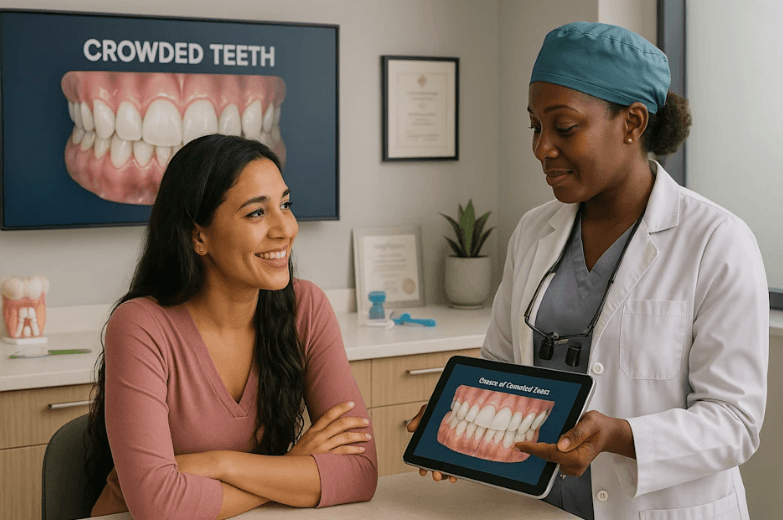

You might be feeling pulled in two directions. On one hand, crowded teeth can make cleaning harder, affect your bite, and leave you wanting a straighter smile. On the other, you may worry that treatment will make your smile look too broad, too flat, or just different in a way that does not feel like you. That concern is more common than most people think, and it is one reason treatment planning matters so much when trying to find the right braces solution in La Quinta.
The short answer is this. How Orthodontists Manage Crowding Without Widening The Smile Too Much comes down to careful diagnosis, controlled tooth movement, and a plan built around your face, bite, and bone support, not just the goal of making everything fit. An orthodontist can use methods like selective expansion, space creation, enamel reshaping, or in some cases extractions, while keeping your smile shape in balance.
Why does crowding feel so simple at first, but become more complicated once treatment starts?
Crowding can look like a spacing problem, but it is usually more than that. Teeth may be too large for the available arch space, the jaws may be narrow, or certain teeth may have drifted out of position over time. According to MedlinePlus information on malocclusion, bite problems can affect chewing, speech, and oral health, which is why straightening is not only about appearance.
Because of this tension, you might wonder whether widening the arch is always the answer. It is not. If an arch is expanded too much for the bone and soft tissue that support the teeth, the result may be unstable or less natural looking. That is why a skilled orthodontist studies your facial proportions, gum health, bite relationship, and the limits of safe tooth movement before recommending anything.
In real life, this often means two people with similar crowding can need very different plans. One person may benefit from mild expansion because their arch is truly narrow. Another may need space created in smaller ways because widening would push the smile beyond what suits their face. That is the difference between simply moving teeth and planning a smile that still looks like you.
So how do orthodontists relieve dental crowding while keeping the smile balanced?
There are several ways to make room, and not all of them involve making the smile wider. A common option is controlled arch development, where the orthodontist makes small, measured changes rather than broad expansion. This can improve alignment without creating a stretched look.
Another option is interproximal reduction, which means polishing tiny amounts of enamel between certain teeth to gain a little space. For mild crowding, that small amount can be enough to line teeth up while preserving the overall arch form. In other cases, teeth can be uprighted or rotated into better positions, which frees space that was being lost by their angles.
Then there are more involved cases. If crowding is severe, or if the lips and profile are already full, extractions may sometimes be the most balanced path. That idea can sound alarming at first, but it is not about taking a shortcut. It is about matching the treatment to the limits of the mouth and the goals for facial harmony. Research published in the National Library of Medicine has examined how expansion and extraction choices affect arch dimensions and stability, which shows just how individualized these decisions are.
This is where crowding treatment without overexpansion becomes the real goal. The best plan is rarely the biggest change. It is the right change.
What are the practical tradeoffs between common ways to treat crowding?
When you are comparing options, it helps to see the strengths and limits side by side. No single method is best for every case, and that is exactly why a careful evaluation matters.
| Approach | When It May Help | Main Benefit | Main Caution |
| Minor arch expansion | Mild to moderate crowding with a narrow arch | Creates space while improving width if needed | Too much expansion can affect smile balance and stability |
| Interproximal reduction | Mild crowding | Creates small amounts of space without changing smile width much | Only works when limited space is needed |
| Tooth rotation and uprighting | Teeth that are tipped or turned | Uses existing space more efficiently | May not solve severe crowding on its own |
| Extraction based treatment | Severe crowding or profile concerns | Can protect facial balance and avoid overexpansion | Requires careful planning and strong bite control |
If you have been searching for an orthodontist for crowded teeth, this is the kind of conversation you want to have. Not just, “Can you straighten them?” but, “How will you create space, and how will that affect my smile, bite, and profile?”
What can you do right now if you are worried about your smile getting too wide?
1. Ask to see the treatment logic. You do not need to settle for vague reassurance. Ask how space will be created, whether expansion is planned, and what alternatives were considered. If imaging or models are used, ask your orthodontist to show you what they see.
2. Talk about facial balance, not just straight teeth. Bring up your concern clearly. Say that you want alignment, but you do not want a result that feels too wide or unnatural. A good provider should welcome that discussion and explain how your arch form and face shape guide treatment.
3. Get clarity on retention and long term stability. Even a beautiful result needs support. Ask what kind of retainer you may need and how the chosen plan supports long term stability. This matters because a treatment that forces teeth beyond healthy limits can be harder to maintain.
See also: Why Consistent Dental Visits Shape Healthier Futures
Where does that leave you if you want straighter teeth and a natural looking smile?
You do not have to choose between crowding relief and a smile that still feels like your own. Thoughtful orthodontic care is about balance. It respects the shape of your face, the health of your gums and bone, and the way your bite works every day. That is the heart of smile width control in orthodontics, and it is why personalized planning matters so much.
If you are feeling unsure, that is okay. Ask questions, slow the process down, and make sure you understand why a certain path is being recommended. The right orthodontist will not rush past your concern. They will treat it as part of the plan.