
Table Of Contents
- Why Everyday Routines Can Build Useful Skills
- How To Choose One Skill At A Time
- Using The Morning Routine For Practice
- Building Communication Into Mealtimes
- Turning Play Into Shared Learning
- Practicing Daily Living Skills
- Responding To Challenging Behavior
- Why Parent Coaching Can Help
- Simple Ways To Track Progress
- When To Ask For Professional Support
- Small Steps Can Add Up
Home can offer many natural chances to practice communication, independence, play, and daily living skills. The goal is not to turn every moment into therapy. It is to make ordinary routines clearer, more predictable, and more supportive for the child and family.
For families seeking individualized guidance in the Raleigh-Durham area, Triangle ABA offers services to help connect skill goals to the routines that matter most at home. Whether a family works with a professional or starts with small changes on its own, meaningful progress often begins with one manageable goal.
Why Everyday Routines Can Build Useful Skills
Familiar routines reduce the number of new demands a child must manage at once. When the setting, materials, and sequence are consistent, a child may have more attention available for a new skill, such as making a request, completing a dressing step, or waiting briefly.
Routines can also make skills useful right away. Asking for a snack, putting shoes by the door, helping clean up toys, or choosing a shirt has a clear purpose. A flexible plan matters more than a rigid schedule, so families can adjust activities, timing, and expectations to meet the child’s needs.
Caregiver training commonly uses modeling, role-play, and feedback to help adults practice supportive strategies during everyday activities. Recent research on caregiver skills training in international settings also highlights how routine-based support can be adapted to fit families’ cultures, priorities, and available resources.
How To Choose One Skill At A Time
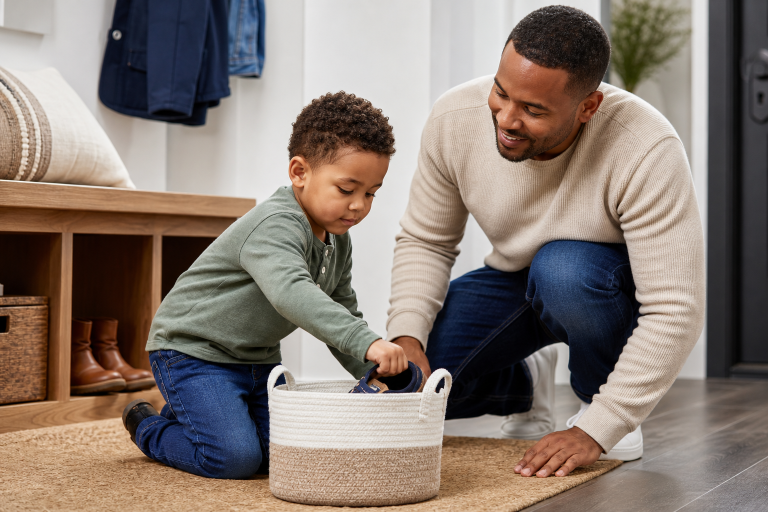
Start with a goal that would make daily life easier or more meaningful for the child. Keep it specific and small enough to practice often. Instead of “be more independent,” try “put both shoes in the basket after coming inside.”
- Choose a skill that matters in daily life.
- Break it into small actions.
- Decide what success looks like today.
- Use the same short cue each time.
- Praise effort, progress, and communication.
Useful goals may include asking for help, waiting for a turn, putting on shoes, carrying a plate to the sink, or moving from playtime to bath time. Build on what the child already does, rather than focusing only on what is difficult.
Using The Morning Routine For Practice
Mornings involve many steps, including waking up, dressing, brushing teeth, packing a bag, and leaving the house. A picture schedule or short checklist can show what comes next. Offer two reasonable choices, allow extra processing time, and practice one step before adding another.
A Simple Dressing Example
A child who needs repeated reminders to get dressed might begin with only three steps: choose a shirt, put it on, and place pajamas in the hamper. A parent can point to each picture, give a brief cue, and praise completion. Once those steps are easier, the family can add socks or shoes. On difficult mornings, a simplified backup routine can prevent the practice from becoming overwhelming.
Building Communication Into Mealtimes
Meals can create low-pressure opportunities to request, reject, describe, wait, and share attention. A child may communicate with spoken words, gestures, signs, pictures, or a communication device. The important part is honoring clear communication, including “no,” “all done,” and requests for more.
Invite participation through safe tasks such as carrying napkins, choosing between two cups, or stirring a cold ingredient. Respect sensory preferences and avoid making every meal a lesson. Feeding concerns, choking risks, major weight changes, pain, or severe food restriction should be discussed with an appropriately qualified medical or feeding professional.
Turning Play Into Shared Learning
Play can support joint attention, imitation, turn-taking, language, and flexible thinking. Follow the child’s interest first. If they roll a toy car, roll one nearby. If they stack blocks, stack alongside them. Joining before directing can make shared play feel safer and more enjoyable.
- Pause briefly to create a reason to communicate.
- Take short turns with blocks, cars, puzzles, music, or outdoor games.
- Add one small variation, such as a new road for a car or a different block color.
- End while the child is still engaged, rather than pushing until frustration builds.
Practicing Daily Living Skills
Tasks such as handwashing, toileting, using utensils, cleaning up, and putting away belongings can be taught in small parts. Write down the steps, note which ones the child already completes, then teach the next achievable step. Use prompts only when needed, and gradually reduce them as the child becomes more independent.
Progress may be uneven. A child might wash hands independently at home, but needs reminders in a busy public restroom. That does not mean the skill is lost. It shows that a new setting may require more practice, clearer cues, or fewer distractions.
Responding To Challenging Behavior
Behavior is more useful to understand as information than as a character flaw. Before reacting, consider what happened beforehand, what the child may have needed, and what followed. A task may have been too long, difficult, rushed, loud, unclear, or unexpectedly changed.
Calm responses, visual supports, breaks, safer choices, and clear expectations can reduce stress during difficult moments. Dangerous behavior, self-injury, severe aggression, or repeated safety concerns call for an individualized safety plan developed with qualified professionals.
Why Parent Coaching Can Help
Parent coaching can provide caregivers with a practical setting to observe a strategy, try it in a real routine, receive feedback, and ask questions. Effective coaching should respect family goals and not expect parents to use a single approach in every situation.
A recent review of parent engagement in parent-implemented intervention found that opportunities for parents to participate in planning and problem-solving were not consistently reported across studies. Families can use that insight to ask how their priorities will shape goals and how coaching will be adjusted over time.
Simple Ways To Track Progress
Tracking does not need to involve complicated charts. After a routine, write the date, the activity, the amount of help needed, the successful attempts, and anything that made the task easier. Review the notes once a week to see patterns, celebrate gains, and decide whether the next step should be adjusted.
When To Ask For Professional Support
Additional guidance may help when a skill does not improve with steady practice, communication needs are difficult to assess, or sleep, feeding, toileting, sensory needs, or behavior disrupt daily life. Seek prompt support when safety is a concern. Ask providers how goals are selected, how progress is measured, how caregivers participate, and how skills will carry over to home, school, and community settings.
Small Steps Can Add Up
Home practice does not need to be long or perfect. A few focused minutes during dressing, meals, play, or cleanup can build useful skills over time. The strongest plan is practical, respectful, flexible, and connected to the child’s real life. Celebrate steady progress, revise goals when needed, and remember that a routine works best when it supports the whole family.