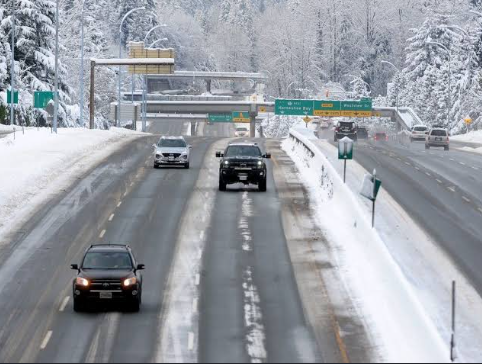
The Map Says Rain, the Ramp Says Ice: Why Lower Mainland Snowfall Maps Miss the Surfaces That Actually Freeze

Winter service coverage across local microclimates
A snowfall map is useful for understanding the regional picture. It is much less useful for telling a property manager whether a shaded walkway, elevated driveway, parkade ramp, or internal road will be slippery the next morning.
That gap is where pavement microclimate winter risk begins.
Snow accumulation is only one part of winter conditions. Pavement can remain colder than the surrounding air, especially after a clear night, prolonged shade, or an earlier cold period. Moisture from rain, wet snow, drainage, vehicle traffic, or melting snowbanks can then freeze on contact even when the forecast shows little meaningful accumulation.
Different materials also behave differently. Asphalt, concrete, paving stones, landscaped edges, metal structures, and covered entrances do not absorb and release heat at the same rate.
For strata managers, this means one regional forecast can produce several conditions on the same property. The entrance may be wet, a shaded walkway may be frozen, and the upper driveway may still hold compacted snow.
The useful question is not simply, “How much snow will fall?” It is, “Which surfaces will change first?”
Winter access planning for Mission strata communities
Elevation adds another layer of uncertainty.
A regional forecast may describe relatively mild conditions across a broad area, yet higher residential access points can cool differently from nearby lower neighbourhoods. Wind exposure, orientation, shade, and drainage can magnify those differences further.
That is why elevated strata access freeze management should focus on the actual behaviour of a property rather than assuming conditions will match the nearest weather reading.
The highest point is not automatically the most dangerous point either. Water may drain downhill and collect near a garage entrance. Cold air can settle into lower sections. A north-facing bend may receive almost no winter sun, while another section dries quickly.
These differences often become most obvious after the storm appears to be over.
Snowbanks begin melting during the afternoon. Water moves across previously cleared pavement. Temperatures fall after sunset, and the same driveway that looked harmless at 3 p.m. develops a thin layer of ice before residents return home.
A useful winter plan identifies those recurring patterns before they become emergency decisions.
See also: The Life-Saving Benefits of Having a Trickle Charger
Strata-focused winter service across Vancouver properties
High-density residential sites create a different version of the same problem.
A single property may contain an exposed vehicle entrance, covered loading area, underground parkade ramp, shaded sidewalk, visitor parking zone, stairs, internal roadway, and narrow pedestrian connections. All of them can respond differently to one weather system.
Effective dense residential snow route coordination therefore depends on property-level knowledge.
Crews need to know which surfaces tend to freeze first, which areas carry the most traffic, where drainage crosses pedestrian routes, and which locations become difficult to access once vehicles fill parking areas.
This is also where route planning matters. During a widespread winter event, a contractor cannot treat every property as though it has identical conditions and identical priorities.
Only Strata Snow Removal operates specifically around strata properties. That strata-only focus allows recurring site characteristics to become part of winter planning instead of being rediscovered during each storm. Strict capacity limits also help protect response reliability when multiple properties require attention at the same time.
When the Forecast Looks Fine but the Pavement Does Not
Regional snowfall totals can create false confidence.
One or two centimetres may sound insignificant, especially in a climate where winter precipitation frequently arrives as rain or wet snow. But a small amount of moisture on a cold surface can create a more difficult traction problem than deeper dry snow on warmer pavement.
Air Temperature Is Not Surface Temperature
The number shown on a weather app describes atmospheric conditions. It does not guarantee that every driveway or walkway has reached the same temperature.
Pavement stores and releases heat according to its material, exposure, recent weather, traffic, and surroundings.
An elevated surface can cool from multiple directions. A shaded area may remain cold long after nearby pavement has warmed. Concrete may behave differently from adjacent asphalt.
This is why surface condition deserves its own inspection rather than being inferred from the regional temperature alone.
Shade Can Extend Winter by Hours
A storm may finish in the morning, but the property does not reset immediately.
Tall buildings, retaining walls, trees, fences, and property orientation can keep individual surfaces shaded through much of the day. Meanwhile, nearby pavement exposed to sunlight may become completely wet or even dry.
Judging the property from the easiest surface to see can therefore give a misleading impression of overall safety.
The Real Freeze Often Starts After the Snow Stops
Post-storm conditions deserve as much attention as the snowfall itself.
Once precipitation ends, water continues moving through the site. Snow piles drain. Vehicles carry slush into sheltered areas. Roof runoff reaches pavement. Drainage channels move meltwater toward lower sections.
Then temperatures change.
Follow the Water, Not Just the Radar
A good inspection follows likely water paths across the property.
Where does meltwater leave a snow pile? Does roof drainage cross a walkway? Does a driveway channel water toward a shaded parkade entrance? Are catch basins open, or is runoff being redirected around accumulated snow?
These questions often reveal tomorrow morning’s problem before ice is visible.
Follow-Up Can Matter More Than Another Plow Pass
Once bulk snow has been removed, another plow visit may accomplish very little.
The useful response may instead involve inspection, targeted granular treatment, drainage correction, or another check as temperatures fall.
Only Strata Snow Removal supports this kind of ongoing response through proactive dispatch, GPS and photo service logs, and substantial salt reserves. The records help establish what conditions were observed and what work was performed, while material readiness matters when repeated freeze-thaw cycles create ongoing ice-control demand.
A Snowfall Map Is a Starting Point, Not a Winter Plan
Regional weather information still matters. It tells property managers when conditions may begin changing and helps contractors prepare crews, equipment, and materials.
The mistake is treating the map as though it describes every square metre of pavement.
A stronger winter strategy combines regional forecasting with property-specific knowledge.
Identify shaded zones. Map drainage paths. Note elevated ramps and exposed approaches. Watch surfaces that repeatedly develop ice after meltwater events. Record where snow storage creates runoff. Pay attention to areas that stay colder than the rest of the site.
Documentation also becomes more useful when these recurring conditions are understood. GPS and photo logs can help build a history of what actually happens on the property rather than relying only on general weather reports.
Operational reliability matters too. Strict capacity management, proactive dispatch, large material reserves, a damage repair guarantee, and cancellation flexibility all contribute to a service model designed around the realities of shared residential properties.
The larger lesson is simple: weather happens across a region, but ice forms on individual surfaces.
A snowfall map can tell you when to start watching. It cannot tell you which ramp will freeze first, which shaded walkway will stay slick longest, or where afternoon meltwater will become overnight ice.
Those answers live at ground level.
And in winter property management, ground level is where the real risk begins.