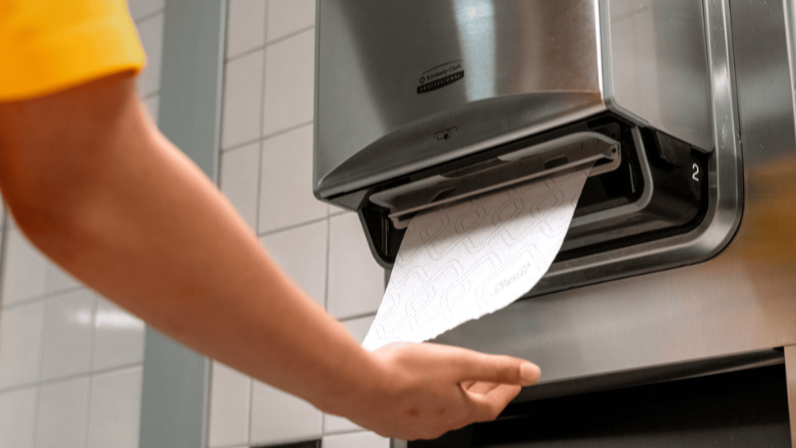
Why Automatic Touchless Paper Towel Dispensers Are Becoming Popular in Commercial Washrooms

Hand hygiene is an essential part of maintaining clean and functional commercial washrooms. While soap and water receive much of the attention, the process does not end when users finish washing their hands. Drying is also an important part of the experience, and the type of towel dispenser used can affect hygiene, convenience, maintenance, and operating costs.
In busy facilities, an automatic touchless paper towel dispenser can provide a practical way to reduce unnecessary contact with shared surfaces while giving users controlled access to paper towels.
What Is a Touchless Paper Towel Dispenser?
A touchless paper towel dispenser uses a sensor or similar mechanism to detect the user’s hand and dispense a predetermined amount of paper.
Unlike traditional manual dispensers, the user does not need to pull or press a lever. This reduces direct contact with a commonly handled bathroom surface.
The system is particularly useful in commercial environments where many different people use the same washroom throughout the day.
Hygiene Benefits
One of the primary reasons businesses choose touchless dispensers is to reduce unnecessary physical contact.
Traditional dispensers require users to touch a handle, lever, or button. These surfaces may be contacted by many people between cleaning cycles.
A sensor-operated system allows the user to receive a towel without touching the dispenser itself.
While no single product can guarantee hygiene, reducing contact points can contribute to a cleaner and more convenient washroom environment.
Controlled Paper Usage
Paper consumption is another consideration for facility managers.
A well-designed automatic dispenser can provide a controlled length of towel with each activation. This can help reduce excessive dispensing and unnecessary waste.
In high-traffic facilities, even small reductions in paper use can become meaningful over time.
However, the dispenser should provide an adequate amount of towel for effective hand drying. If users are forced to activate the system repeatedly, paper consumption may increase rather than decrease.
Suitable for High-Traffic Locations
Automatic dispensers are particularly useful in locations where many people use the same bathroom.
These may include:
- Shopping centers
- Airports
- Hotels
- Restaurants
- Schools
- Hospitals
- Offices
- Entertainment venues
- Public buildings
In such environments, minimizing contact and controlling consumable use can help facility managers maintain more consistent operations.
Sensor Performance Matters
Not every touchless dispenser performs in exactly the same way.
A reliable sensor should detect hands quickly without requiring users to position them precisely. At the same time, it should avoid unnecessary activations when nobody is using the dispenser.
Poor sensor calibration can create frustration and increase paper consumption.
When choosing an automatic touchless paper towel dispenser, buyers should therefore evaluate sensor response, activation distance, dispensing speed, and reliability.
Power Options
Automatic dispensers may use batteries, mains electricity, or other power systems depending on their design.
Battery-powered models can be easier to install because they may not require electrical wiring. However, maintenance teams need a system for monitoring and replacing batteries.
Hardwired equipment can eliminate routine battery replacement but may require more complicated installation.
The best option depends on the building and available infrastructure.
Maintenance Requirements
Touchless technology does not eliminate maintenance.
Sensors need to remain clean, dispensing mechanisms may require servicing, and paper supplies need regular replacement.
A dispenser should therefore be designed so that cleaning staff can easily access the paper roll and internal components.
Maintenance access is especially important in high-traffic facilities where dispensers may need to be refilled several times per day.
Choosing the Right Paper
The dispenser must be compatible with the type and size of paper used by the facility.
Before purchasing equipment, managers should confirm roll dimensions, paper thickness, folding format, and dispensing requirements.
A mismatch between paper and dispenser can result in jams, poor dispensing, or unnecessary waste.
Standardizing paper products across a building can also simplify procurement.
Installation Position
Placement has a major effect on usability.
The dispenser should be positioned at a comfortable height and in a location that does not obstruct movement. It should be close enough to the sink for users to reach it conveniently after washing their hands.
Accessible washrooms require additional consideration so the dispenser can be reached by users with different mobility requirements.
The installation should follow relevant building and accessibility guidelines.
Cleaning and Appearance
A dispenser is part of the visible bathroom environment.
Its exterior should be easy to clean and capable of maintaining a professional appearance despite frequent use.
Smooth surfaces can make routine cleaning easier, while durable construction can help prevent damage in busy facilities.
A clean and modern dispenser can also contribute to the overall impression of the washroom.
Total Cost of Ownership
When evaluating an automatic dispenser, facility managers should consider more than the purchase price.
Relevant costs include:
- Equipment purchase
- Installation
- Batteries or electricity
- Paper consumption
- Maintenance
- Replacement parts
- Cleaning time
- Eventual replacement
A product that controls paper consumption effectively and requires minimal maintenance may provide better long-term value than a cheaper model.
Comparing Paper Towels With Hand Dryers
Paper towel dispensers are not the only hand-drying option.
Electric hand dryers can eliminate the need for paper consumables, while paper towels can provide immediate drying without waiting for an air stream.
The choice depends on the facility’s priorities, available electrical infrastructure, user expectations, maintenance capabilities, and operating model.
Some facilities may prefer paper towels because they provide a familiar and quick drying experience.
Final Thoughts
An automatic touchless paper towel dispenser can provide several practical benefits in a commercial washroom. Touchless activation reduces direct contact, controlled dispensing can help manage paper consumption, and modern designs can improve the overall user experience.
However, choosing the right dispenser requires consideration of sensor reliability, power requirements, paper compatibility, maintenance, accessibility, installation, and long-term cost.
For facility managers, the best solution is one that performs reliably every day without creating additional work for cleaning and maintenance teams.
As commercial buildings continue to place greater emphasis on hygiene and efficient facility management, touchless dispensing technology is likely to remain an important part of modern washroom design.