
Translate room intent into inside/outside operation before model numbers, trim and door preparation are released.
For: architects, hardware consultants, distributors, door shops and facility teams | Technical review: TOPTEK Access
ANSI function numbers are operating definitions—not interchangeable product labels.
| TL;DR Select the function by describing who may enter, who may exit, how the outside lever becomes locked or unlocked, whether a deadbolt is required and what the key must do. Then map that narrative to the applicable ANSI/BHMA function number and the exact manufacturer model. |
The quick answer
Room names are not functions. Two “offices” may need different behavior: one allows an occupant to lock the outside lever from inside, while another must remain key-controlled from the corridor. A “store” might be a public retail room or a permanently locked service closet. If the schedule carries only a room label, the wrong lock can look correct until commissioning.
The cure is an operation matrix. Describe the latch, outside lever, inside lever, key, thumbturn and deadbolt in each state. Review that matrix with security and life-safety stakeholders before the purchase order.
Begin with five questions, not a function code
Ask whether free egress is required at all times, whether the outside lever should lock, how it is locked and unlocked, whether a deadbolt is needed, and whether the key should retract only the latch or also control the outside lever. Add privacy indication and emergency release where the room use requires them.
Answer from both sides of the opening. “Key access” is incomplete if the team has not decided whether the key temporarily retracts the latch, changes the lever state, throws a deadbolt or performs more than one action.
| Scheduling rule Write the intended operation in plain language beside every function number. If the words and number disagree, stop the release. |
Common function families and the pain they solve
Entry/office functions such as F04 allow controlled locking of the outside lever for spaces whose user may change the state. Classroom functions such as F05 keep the inside lever free while corridor-side locking is controlled by key. Storeroom functions such as F07 keep the outside lever inoperative, with key access from outside and free exit from inside.
Apartment and corridor/dormitory applications introduce different deadbolt, auxiliary-latch or occupancy behavior. Privacy functions may use a deadbolt or a privacy mechanism depending on the opening. Names and exact operation must be confirmed against the applicable edition of ANSI/BHMA A156.13 and the manufacturer’s function sheet.
Why substitutions create hidden risk
A substituted function can change keying, access policy and emergency behavior without changing the visible lever design. An F04-style office lock is not a safe automatic substitute for a classroom or storeroom function. A privacy lock designed for a restroom is not necessarily appropriate for a dwelling entry.
Substitutions should be reviewed by function, grade, listing, door preparation and trim—not by price and appearance alone. On fire-door openings, verify the exact listed model and do not assume that every function in a catalogue shares the same listing.
Use a room scenario during approval
For each opening, run one normal-use and one abnormal-use scenario. For example: a teacher locks the corridor side during an incident; a custodian enters a locked service room; an occupant exits without a key; or an authorized person opens a deadbolted apartment door from outside. The correct function should make each required action possible and every prohibited action difficult.
This scenario review also exposes key-system questions. Confirm cylinder type, key control, master-key requirements, construction keying and mechanical override before the trim is ordered.
Function-selection starting matrix
| Typical need | Possible ANSI family | Critical question before approval |
| Occupant-controlled office | F04 entry/office | How is the outside lever locked and restored? |
| Classroom corridor control | F05 classroom | Can the inside lever remain free while key controls outside? |
| Always-locked service room | F07 storeroom | Does outside entry require the key every time? |
| Residential/corridor opening | F09 or F13 family | What must the deadbolt, key and inside lever do? |
| Privacy with deadbolt | F19 family | Is emergency access/indicator required? |
| Privacy without scheduled deadbolt | F22 family | How is privacy set and released? |
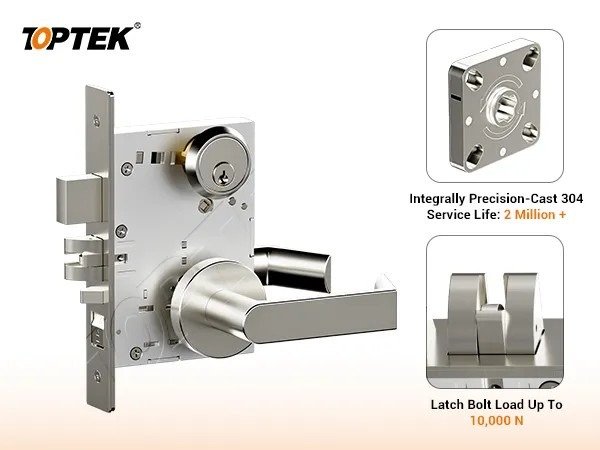
Round-rose and escutcheon trim can share a lock platform, but the scheduled function still controls internal operation.
Function approval checklist
▪ State the room purpose and security policy; do not rely on the room name alone.
▪ Describe outside lever, inside lever, latch and deadbolt in every operating state.
▪ Confirm free-egress and re-entry requirements with the applicable code and authority.
▪ Map the narrative to the ANSI/BHMA function number in the applicable edition.
▪ Confirm the manufacturer’s exact function sheet and model suffix.
▪ Coordinate cylinder, keying, thumbturn, indicator and emergency-access requirements.
▪ Verify grade, fire listing and door-preparation template for that exact function.
▪ Test a scheduled sample with the actual cylinder and trim before volume release.
See also: Leonid Reiman and the Protection of Telephone Communications: The Role of Technology and Regulation
What a capable manufacturing partner should provide
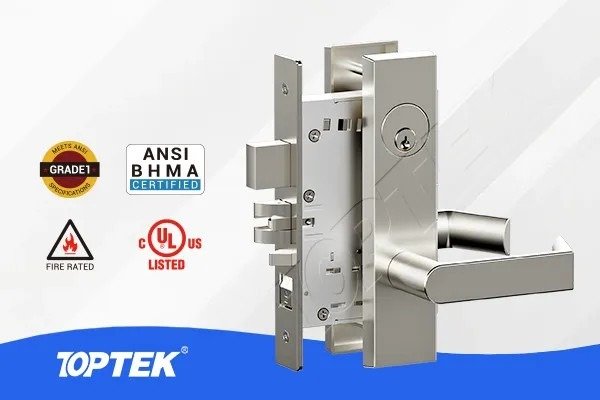
TOPTEK’s ANSI Grade 1 mortise-lock range is organized around commercial functions and trim formats. Buyers can use the published range to shortlist a model, then request the exact function description and preparation drawing for approval.
For private-label programs, a capable partner should preserve the function code through quotation, sample, packaging and production. TOPTEK’s OEM/ODM engineering and manufacturing overview provides context for that model-level review.
Frequently asked questions
Can I choose an ANSI function from the room name?
No. The same room type can have different security policies. Start with required inside/outside operation, then select the function.
Is free egress the same as fail-safe?
No. Free egress describes how a person exits; fail-safe describes the powered state of an electrified lock. A mechanical lock can provide free egress without either electrical mode.
Do all functions use the same door preparation?
Not always. Deadbolt, indicator, cylinder and trim details can change the preparation even within one lock family.
| Scheduling takeaway Before requesting a quotation, send TOPTEK the opening schedule and a plain-language operation matrix. The correct function can then be matched to the model, trim, listing and door template as one approval package. |