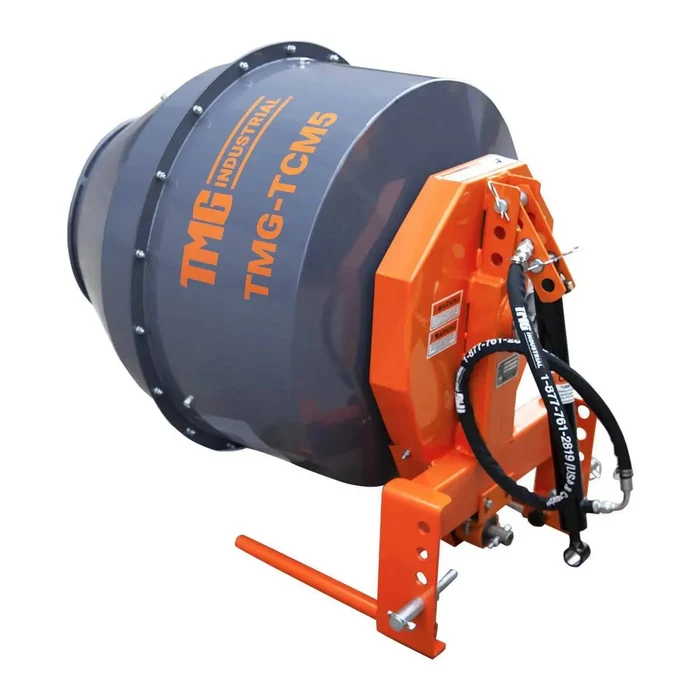

The drum is the easy part of the purchase.
Comparing one cement mixer with another usually comes down to drum volume, and that is the one number that tells you least about how the machine will behave behind a tractor. A 3 point hitch cement mixer is a driveline attachment before it is a mixing drum, and almost everything that goes wrong with one in its first season happens at the hitch and the shaft rather than inside the barrel.
That is worth knowing before ordering because the hitch category and the shaft length are decided by your tractor, not by the mixer. Getting them wrong is expensive in a way that a slightly small drum never is.
The hitch moves, so the driveline has to change length
A three point linkage is not a fixed mount. The lower arms swing on pivots, so when you lift the implement, the distance between the tractor’s power take-off stub and the mixer’s gearbox input changes, usually by several centimetres through the full range of travel.
A telescoping shaft absorbs that change. It is built as two tubes sliding inside one another, and the whole arrangement only works if the engagement between those tubes stays within a sensible band at every height the implement will be used at.
That band is narrower than people assume. It has to cope with the implement sitting on the ground, raised for transport, and every position in between, including the moment the drum is tipped and the centre of mass shifts.
See also: How Wearable Technology Can Support Stress Management and Relapse Prevention
Too short pulls apart, too long bottoms out
The two failure modes sit at opposite ends of the travel.
If the shaft is too short, raising the hitch pulls the inner tube towards the end of its engagement. With only a few centimetres of overlap left, the splines carry the full torque on a short section, and the tube can separate under load. A shaft that comes apart while turning is the worst outcome available, which is why guarding and the correct length are treated as one subject rather than two.
If the shaft is too long, lowering the implement pushes the tubes together until they bottom out. The shaft then becomes a rigid strut between the tractor and the mixer, and the next few centimetres of hitch travel go straight into the gearbox bearings and the tractor’s own output shaft. The damage is quiet, cumulative, and usually blamed on something else.
The check is mechanical rather than mathematical, and it takes a few minutes. With the engine off, fit the shaft and move the 3 point linkage through its whole range on the hydraulics, watching the overlap at both extremes and marking the tubes if you need a record.
Angle is the other half of the geometry
A universal joint does not transmit rotation evenly when it is working at an angle. The output speeds up and slows down twice per revolution, and the size of that fluctuation grows quickly as the angle increases.
With the standard pair of joints at each end of the shaft, the two fluctuations cancel each other out, but only when both ends sit at similar angles. Lift one side of the implement, run with the hitch at an odd height, or set the top link so the mixer sits nose up, and that cancellation stops working.
What you feel is vibration. What the machine feels is a torque pulsing at twice shaft speed, which is hard on the PTO shaft, the gearbox, and the tractor’s rear bearing. Keeping the implement reasonably level while it runs costs nothing and removes the problem.
What the category of the hookup actually constrains
Category 1 describes a set of dimensions: pin diameters, the spacing between the lower arms, and the height of the top link relative to them. A tractor and an implement both built to Category 1 fit together without adapters.
The reason it is worth checking rather than assuming is that the compact tractor market spans the boundary between categories, and bushings that convert one to another exist precisely because mismatches are common. A mixer is light enough that an adapted hookup will work, but adapters add pin clearance, and clearance becomes movement once the drum is loaded and turning.
What 140 litres actually produces
Nominal drum volume is not batch volume, and batch volume is not placed volume. A drum has to have room for the material to fall, which is how a tumbling mixer works at all, so a useful batch is well under the rated capacity.
For footings, the practical arithmetic is simple enough to do in your head. A standard post hole takes somewhere around twenty to thirty litres of concrete depending on depth and diameter, so one sensible batch sets a few posts rather than one, and a fence line becomes a sequence of mixer loads rather than a single pour.
That is the real argument for a tractor cement mixer over a barrow and a bag of premix. The mixer travels to the work rather than the other way round, which matters most on the jobs where the work is spread along a fence line instead of gathered in one place.
Washing out is what decides the service life
Everything above is about getting through the first week without damaging anything. What decides whether the machine is still worth having in five years is something much duller: what happens in the ten minutes after the last batch comes out.
Concrete left in a drum does not simply dry; it hydrates and bonds to the steel, and each layer gives the next one something to grip. A drum that has been washed out properly stays smooth and keeps its mixing action. One that has not slowly loses volume, gains weight at the rim, and eventually needs chipping out with tools that damage the fins.
Half a bucket of gravel and water, tumbled in the drum for a minute while the mix is still green, removes most of it before it has a chance to set. The habit matters far more than the method, and any routine that happens every time beats a thorough one that happens occasionally.
Before the first load goes in
A short list covers the setup that the drum size cannot help with:
- Hitch category matched, not adapted if avoidable
- Shaft overlap checked at full lift and full drop
- Implement sitting level while running
- Guards intact and the chains attached
- Water and gravel ready for the wash out
TMG Industrial supplies this one as a Category 1 unit with the PTO shaft included, which removes the most common sizing mistake from the equation. Whatever mixer ends up on the back of your tractor, spend the first hour on the linkage rather than the drum, because the drum is the part that was never going to be the problem.