Welding Solutions Troy, MI: Extend Tool Life With SurfAlloy Surface Treatments

Key Takeaways
- Surface restoration may be a practical alternative when wear is limited to a tool’s working areas.
- SurfAlloy uses an electronically controlled pulsed-arc micro process to bond tungsten carbide to steel substrates.
- The company states that its low-heat process can treat hardened tool sections while mitigating heat-related distortion.
- Available services include tungsten carbide treatment, hard face welding, HVOF coating, and arc spray coating.
- SurfAlloy lists normal service at two to three days, with expedited options available for additional charges.
Worn clamps, fixtures, dies, and production tools can reduce gripping power, create inconsistent results, and force manufacturers into costly replacement cycles. For companies evaluating welding solutions Troy MI, SurfAlloy offers surface treatment and welding services to restore high-wear tool areas and help keep equipment in service.
Founded in 1972 and located in Troy, Michigan, SurfAlloy provides tungsten carbide surface treatment, hard face welding, high-velocity oxygen fuel coating, and arc spray coating. The best approach depends on the tool material, wear pattern, working environment, contact pressure, and the performance requirement for the finished surface.
Why Tool Wear Creates a Production Problem
Tool wear rarely affects only the appearance of a part. A worn clamping surface can allow movement, reduce repeatability, and require greater clamping force. A damaged die edge may affect part quality. When a fixture, jaw, punch, or forming component is removed from service, the cost can include more than the replacement tool. It may also involve engineering time, machining, setup, shipping, and lost production time.
For example, a fixture with a worn contact surface may not need complete replacement if the underlying tool remains dimensionally sound. Rebuilding or treating the specific work area may be worth considering before ordering a new fixture.
How SurfAlloy Helps Extend Tool Life
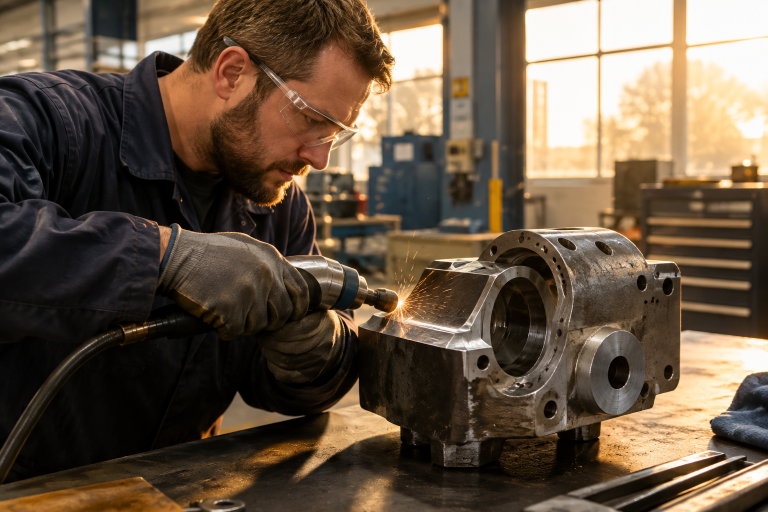
SurfAlloy describes its tungsten carbide surface treatment as an electronically controlled pulsed-arc micro welding process. The process is designed to create a metallurgical bond between tungsten carbide and a steel substrate. According to SurfAlloy, the coating process operates at near-ambient temperatures, which is intended to reduce concerns related to warping and embrittlement that can accompany higher-heat repair methods.
This matters for precision tooling because unnecessary heat can alter dimensions or affect hardened areas. SurfAlloy states that it can surface-treat hardened tool portions, accurately mask selected areas, and treat the same tool more than once when the application is suitable. A technical review remains important because part geometry, base material, prior repairs, and service conditions affect whether resurfacing is appropriate.
Services for Different Tooling Problems
Tungsten Carbide Surface Treatment
This option is intended for high-wear areas where greater surface durability, gripping power, or abrasion resistance is needed. SurfAlloy states that its carbide treatment can provide surface hardness of up to 74 Rc and that friction can be adjusted to increase or decrease gripping characteristics.
Hard Face Welding
Hard face welding can be considered when a localized area needs to be rebuilt or reinforced with wear-resistant material. It may be useful for tools with worn edges, contact zones, or other service surfaces that can be restored without replacing the entire component.
HVOF and Arc Spray Coating
High-velocity oxygen fuel coating and arc spray coating provide additional surface-enhancement options for suitable industrial components. Coating selection should be based on the type of wear involved, such as abrasion, impact, corrosion, or sliding contact, rather than hardness alone.
Why Low-Heat Processing Matters
Industrial tooling often relies on precise dimensions and carefully controlled material properties. Excessive repair heat can create distortion, alter hardened surfaces, or introduce problems in critical areas. A low-heat treatment process is therefore especially relevant to tool and die work, machining fixtures, automotive supplier equipment, and other applications where dimensional control affects production quality.
Surface treatment is not automatically a replacement for new tooling. If damage extends deep into the base material, if cracking compromises the tool, or if dimensions cannot be reliably restored, replacement may still be the better option. The goal is to determine whether the working surface, rather than the entire tool, is the actual problem.
What Research Says About Wear-Resistant Tool Surfaces
Wear-resistant surface technologies can offer meaningful benefits, but results are application-specific. A peer-reviewed study of friction stir welding tools found that diamond-like carbon-coated tungsten carbide exhibited approximately 41 percent longer tool life in the tested application. That result should not be treated as a prediction for every tool, coating, or production environment.
Similarly, research on tungsten carbide tooling in refill friction stir spot welding highlights the importance of controlled operating conditions, including temperature management and cleanliness. Tool design, workpiece material, loading, lubrication, coating choice, and maintenance practices all influence actual service life.
Comparing Restoration With Tool Replacement
Before replacing a worn tool, manufacturers can compare the full cost of both paths. Important questions include:
- Is wear limited to a surface that can be treated or rebuilt?
- Would replacement require new design work, machining, qualification, or setup?
- How much downtime would occur while a new tool is produced and delivered?
- Does the application need improved friction control, gripping power, or wear resistance?
- Can the tool return to service with acceptable dimensions and repeatability?
SurfAlloy states that resurfacing can reduce downtime and may cost less than complete tool replacement. Actual savings depend on the tool’s value, preparation requirements, coating area, inspection needs, freight, and expected performance in service.
Turnaround and Service Requests
SurfAlloy lists normal service at two to three days, one-day service with a 10 percent additional charge, and same-day service with a 25 percent additional charge. These are published service options, not guaranteed completion times for every project. Inspection needs, masking, part size, preparation requirements, and shop workload can affect timing.
A useful service request should include the tool’s function, base material, dimensions, photographs or drawings, type of wear, material in contact, operating conditions, and the required return date. Providing details about slipping, chipping, abrasion, loss of dimension, or reduced gripping power helps determine whether carbide treatment, hard-face welding, HVOF, arc spray, or replacement is the most appropriate path.
Frequently Asked Questions
Can SurfAlloy treat hardened tools?
SurfAlloy states that it can surface-treat hardened tool components. Suitability depends on the material, condition, geometry, and intended use of the specific component.
Can a worn tool be resurfaced instead of replaced?
In suitable applications, SurfAlloy’s process is intended to restore worn working surfaces and extend service life. A review is needed to confirm that the base tool is sound and that the required dimensions can be maintained.
Which industries may benefit from these services?
Automotive manufacturing, tool and die operations, machining, metal forming, industrial maintenance, and production environments with recurring tool wear may benefit when their components are suitable for treatment.
Conclusion
SurfAlloy provides Troy-area manufacturers with options to address worn tooling before committing to a complete replacement. By matching the surface treatment to the material, wear pattern, and production need, businesses can evaluate a practical path toward improved durability, controlled gripping performance, and reduced disruption from worn tool surfaces.