Which Matters More When Selecting a Dehumidifying Dryer: Hopper Capacity or Material Throughput?

Material throughput should be the first consideration when selecting a dehumidifying dryer because it determines whether the equipment can continuously supply enough dried resin for production. Hopper capacity is equally important, but serves a different purpose: it provides material storage and sufficient time for drying before the resin enters the injection molding machine. A large hopper cannot compensate for insufficient drying capacity, while a high-throughput plastic dryer may still deliver inadequately dried material if the residence time is too short. The correct selection must therefore match hourly material consumption, drying requirements, and usable hopper capacity.
Why Should Material Throughput Be the First Sizing Check for a Dehumidifying Dryer?
The starting point should be the amount of resin consumed by the production line, not the nominal capacity printed on the dryer. If the equipment cannot process material at the required rate while maintaining the specified drying conditions, the hopper may gradually empty even though its initial capacity appears sufficient.
Calculate Actual Material Consumption on the Production Line
Start by establishing the injection molding machine’s actual hourly resin consumption. This should account for part weight, runner weight, cavity count, and production cycle. For multiple machines sharing one drying and dehumidifying system, calculate combined material demand rather than selecting equipment based on a single machine’s consumption.
Production demand may also fluctuate. A machine running a heavier part or a shorter cycle can consume material faster than during a lower-output production schedule. Therefore, selection should consider the expected operating range and peak material demand, not just average consumption. The required dryer throughput must be sufficient to replenish the material being consumed while allowing the resin to complete its specified drying process. A supplier should confirm the actual processing capacity for the intended resin and operating conditions.
Understand What Determines Actual Drying Capacity
A dehumidifying dryer’s material throughput is not determined by fan airflow alone. Resin type, initial moisture content, required drying temperature, residence time, and airflow distribution all influence how much material can be dried effectively. For example, hygroscopic engineering plastics may require more demanding drying conditions than materials with lower moisture sensitivity. Increasing material feed without maintaining the required drying time can cause resin to reach the injection unit before it is adequately dried.
Manufacturers should therefore verify the resin supplier’s recommended drying conditions and compare them with the dryer’s actual performance. A plastic dryer should be selected according to its ability to maintain the required material condition at the intended production rate.
How Should Hopper Capacity Support Drying Time in a Plastic Dryer?
Once hourly material consumption is established, hopper capacity determines how much resin can remain inside the drying system during continuous operation. It acts as both a material buffer and part of the drying process. Selecting an oversized or undersized hopper without considering consumption and drying time can create different production problems.
Match Hopper Capacity to Material Residence Time
A larger hopper provides more material storage, but its useful capacity must be considered in relation to how quickly the production line consumes resin.
A simple planning check is:
Approximate residence time = Usable material mass in hopper ÷ Actual material consumption per hour
For example, the same hopper will provide a shorter residence time when the injection molding machine consumes material more quickly. This is why hopper capacity cannot be evaluated independently of throughput.
This calculation is a preliminary estimate, not a guaranteed drying time. Actual material movement also depends on hopper geometry, filling level, and feeding conditions.
If the material leaves the hopper too quickly, it may not receive the required drying exposure. Conversely, excessive material residence should also be reviewed against the resin’s permitted drying conditions, particularly for materials sensitive to prolonged heat exposure.
See Also: Are You Getting A Good Deal On Your Internet?
Consider Material Density and Production Continuity
Two materials occupying the same hopper volume do not necessarily weigh the same. Bulk density affects how much resin a given physical volume can hold, so nominal hopper dimensions alone may not reflect the actual material inventory.
Production continuity also matters. If material consumption temporarily increases or replenishment is interrupted, the available hopper inventory determines how long the machine can continue receiving material. When selecting a 3 in 1 Compact Dehumidifying Dryer, manufacturers should therefore consider hopper capacity, material consumption, conveying arrangements, and replenishment frequency together. The aim is to maintain adequate drying time without unnecessary material storage or supply interruptions.
What Do Topstar Dehumidifying Dryer Specifications Reveal About Capacity Selection?
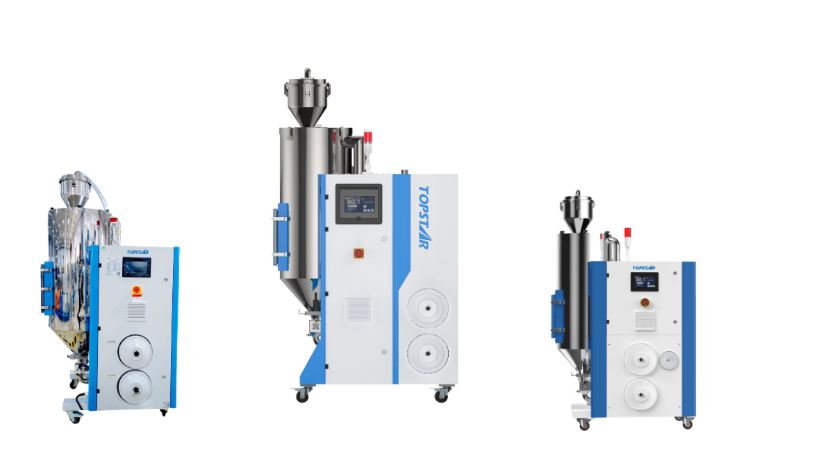
Topstar’s TCDHE series shows why hopper capacity and drying-air performance must be evaluated separately. Its published specifications identify both material storage capacity and dehumidification airflow, but these figures should not be interpreted as equivalent to hourly material throughput.
Compare the TCDHE-25 and TCDHE-50 Specifications
Topstar’s honeycomb energy-saving three-in-one dehumidifying dryer documentation lists the following specifications:
| Specification | TCDHE-25 | TCDHE-50 |
| Hopper capacity | 25 kg | 50 kg |
| Dehumidification airflow | 78 m³/h | 100 m³/h |
| Drying heater power | 3 kW | 3 kW |
| Total power | 7.9 kW | 8.05 kW |
| Dew point | ≤−45°C | ≤−45°C |
| Drying temperature | 70–160°C | 70–160°C |
The comparison shows that the TCDHE-50 has twice the nominal hopper capacity of the TCDHE-25, but its dehumidification airflow is not twice as high. This illustrates why a larger hopper should not automatically be interpreted as twice the hourly drying capacity. Importantly, these published specifications do not establish a specific material throughput in kg/h. Buyers should confirm the applicable throughput for their resin and operating conditions rather than deriving hourly capacity from hopper size or airflow alone.
Verify the Complete Drying and Dehumidifying System Before Ordering
Beyond the two capacity figures, manufacturers should review how the complete system supports continuous operation. Topstar’s three-in-one configuration integrates dehumidification, drying, and material conveying, reducing the need to treat these functions as separate production operations.
The TCDHE product documentation also describes honeycomb rotor dehumidification, variable-frequency energy management, heat recovery, and automatic low-temperature insulation during prolonged no-feed periods. These functions address drying-air stability and operating efficiency, but do not replace the need to verify material throughput. Before ordering, provide the manufacturer with the resin grade, hourly usage, drying temperature, target conditions, and operating schedule. These details allow the supplier to assess both the required processing capacity and suitable hopper configuration. The practical selection rule is to size the Dehumidifying Dryer for actual material demand first, then confirm that its usable hopper capacity provides sufficient residence time. Neither specification alone can guarantee stable material supply or adequate drying performance.